
I’ve dealt with mice in my own house twice, and both times the fix came down to the same three things done together, what the CDC calls “Seal Up, Trap Up, Clean Up”: sealing every gap a mouse or rat can fit through, sanitation that removes what feeds and shelters them, and trapping the ones already inside. Poison sounds like the fast option. It usually isn’t, and it creates a second problem once the pest dies somewhere you can’t reach.
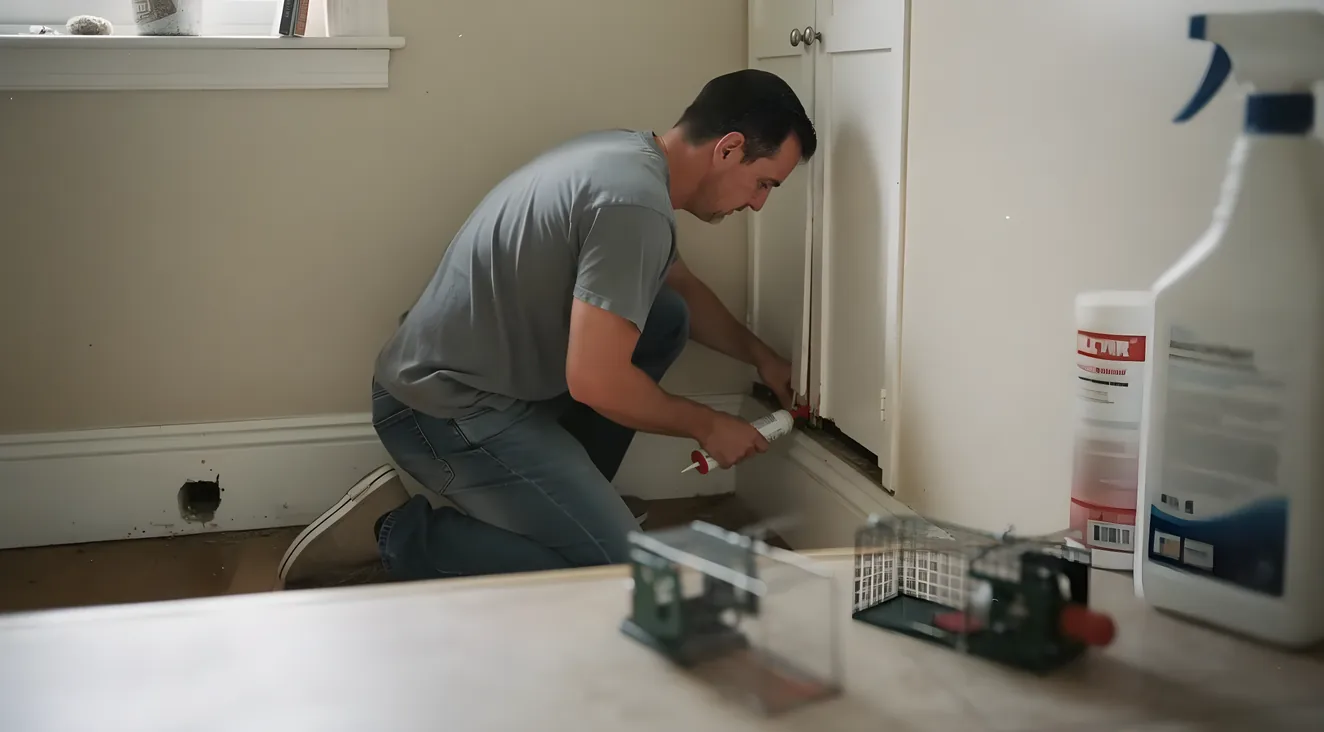
Mice and rats aren’t the same job. A quarter-inch gap, about a pencil’s width, is all a mouse needs to get in. Rats need roughly double that, closer to the width of a quarter. Get the sizing wrong and every other step is wasted, because new rodents just walk in through the same gaps you sealed for the wrong species.
There’s no real overnight fix that skips poison, and poison brings its own set of problems indoors, which is most of what this post is about. A small, recent problem, a few mice, no established nest, typically clears in one to two weeks of consistent trapping and sealing. If you’re three weeks in with no drop in activity, or you’re dealing with rats instead of mice, that’s usually where DIY tools stop being enough.
You’re not imagining how common this is either. A 2017 NPMA survey found roughly a third of U.S. homeowners spot a rodent in their house in a given year, and rodents get into an estimated 21 million homes each winter, per National Pest Management Association survey data. This is exactly the kind of job I write about on Homerous: real numbers and failure modes, not a sales pitch dressed up as advice.
Mouse or Rat? How to Tell What You’re Dealing With
Before you buy a single trap, figure out which animal you’re actually up against. The house mouse (Mus musculus) and the two common rats, the Norway rat (Rattus norvegicus) and the roof rat (Rattus rattus), need different trap spacing, different bait, and different-sized sealing materials. Treating “rodent” as one generic animal is the mistake most advice online makes.
Droppings are the fastest tell. Mouse droppings are small, 3 to 8 millimeters, smooth with pointed ends, and scattered along wherever the mouse has been eating. Rat droppings are dramatically bigger, a half inch to three quarters of an inch, shiny black, and they show up clustered in a repeated run instead of scattered around.
Gnaw marks scale the same way. Rat teeth leave marks around an eighth of an inch across. Mouse marks are smaller and rougher looking, more of a scratchy gouge than a clean bite.
Sound is a decent third signal if you haven’t found droppings yet. Mice make a light, quick scratching, almost like fingernails tapping fast on a hard surface. Rats are heavier: scampering, thumping, sounds that wake you up rather than ones you have to strain to notice.
There’s a fourth signal worth checking even without droppings: grease trails. Rodents run the same route night after night, and the oil in their fur leaves a dark, faintly greasy smudge everywhere their body brushes a surface, along baseboards, in corners, around pipe openings. A rub mark like that confirms an infestation on its own, and it’s also the clue that tells you exactly where to set a trap later.
One more detail that changes where you look: Norway rats burrow and stay ground level, basements, crawlspaces, under debris outside. Roof rats climb, so their sign shows up in attics and upper floors instead. That matters later, because it changes where you’ll be sealing gaps and setting traps.
One thing worth knowing, briefly: the deer mouse, a different species from the common house mouse, is the primary U.S. carrier of hantavirus. Hantavirus is a real but rare disease risk tied to that specific species, which is part of why you clean up droppings with gloves and a mask instead of a bare hand and a broom.
Quick ID: Mouse or Rat
Mouse
Droppings: 3-8mm, pointed ends, scattered
Gnaw marks: small, rough gouges
Sound: light, fast scratching
Location: anywhere, ground to attic
Rat
Droppings: 1/2 to 3/4 inch, shiny, clustered
Gnaw marks: about 1/8 inch, clean bite
Sound: heavy thumping, scampering
Location: Norway rats ground level, roof rats attic and upper floors
How Rodents Are Actually Getting In (and the Size That Matters)
A mouse doesn’t need a hole. It needs a gap the width of its skull, because the skull is the limiting dimension, not the ribcage or the rest of the body. Once the head fits, the rest of the animal follows. That’s why a gap that looks too small to worry about usually isn’t.
Here’s the sizing that actually matters, species by species:
| Rodent | Minimum gap it can enter | Everyday comparison |
|---|---|---|
| House mouse | 1/4 inch (6mm) | About the width of a pencil |
| Norway rat / roof rat | 1/2 inch | About the width of a quarter |
The CDC states the mouse figure directly on its rodent-control guidance. The rat figure is consistent across pest-identification sources and roughly doubles the mouse threshold, which tracks with the size difference between the two animals.
Where these gaps actually show up: foundation cracks and vents, gaps under door thresholds, roofline and soffit gaps, and anywhere a pipe, wire, or dryer vent passes through an exterior wall. None of these are exotic. Most people just never crouch down and inspect them.
Rodents aren’t limited to ground-level entry either. Mice and rats both climb, siding, gutters, tree branches that touch the roofline, even wires running to the house, so a gap under the eaves is just as real a way in as a foundation crack. Skip the roofline and you’ll have sealed the obvious gaps but still have rodents a month later.
Sealing Them Out: Materials That Actually Hold
Sealing is the step that decides whether trapping actually sticks. Skip it and you’re not solving the problem, you’re just thinning out a population resupplied through the same gaps.
Small gaps: pack them tight with steel wool, then caulk over it so it can’t be pulled or clawed back out. Steel wool works because rodents can’t chew through the fine metal fibers the way they chew through wood or foam. The catch: plain steel wool rusts and stains over time. Copper mesh does the same job without the rust, and it’s worth the extra cost around pipes you won’t check regularly.
Gaps too big for steel wool: hardware cloth is the right material. Use the galvanized or stainless kind, 23 gauge, with openings no larger than a quarter inch. Overlap the opening generously and fasten the edges down so it can’t be pried loose.
Expanding foam alone: does not work as a rodent barrier. Rodents chew straight through cured foam like it isn’t there. Foam is still useful, but only as the material that locks a metal mesh in place, not as the barrier itself. If you’ve foamed a gap and skipped the mesh, you haven’t actually sealed it.
The largest openings: garage door gaps, big foundation voids, put you into concrete mortar or sheet metal territory, materials a rodent has no chance of chewing through. While you’re at it, move firewood stacks, debris piles, and dense brush a few feet off the foundation. It removes the cover rodents use to approach the house undetected.
Trapping: What Works, What the CDC Says to Skip
Snap traps are what I use, and they’re what the CDC actually recommends over glue or live traps for reducing rodents in a house. Most sites frame this as a humane-treatment issue. The CDC’s actual reasoning is about disease exposure: a live rodent caught in a glue trap or a live/catch trap gets stressed, and a stressed rodent is more likely to urinate, which raises the risk of pathogen exposure when you handle and dispose of it. A snap trap kills instantly and takes that exposure risk off the table entirely.
Bait: a small amount of chunky peanut butter or mutton fat pressed onto the trigger pad. Cheese sounds obvious, but it dries out and loses its pull fast, peanut butter holds its scent much longer.
Placement: matters as much as the trap itself. Rodents travel along walls and edges, not across open floor, so that’s where the traps go: against baseboards, behind appliances, inside cabinets, anywhere you’ve actually seen droppings or the grease trail you already checked for. Set the trap perpendicular to the wall, with the bait end facing in toward it, so the rodent runs straight into the trigger rather than around it.
How many traps: don’t set one or two and call it done. A real infestation needs real numbers: at least six traps placed through the house, or roughly one trap per meter of wall in the areas where you’re seeing activity. Health Canada goes further, five to ten traps per visible mouse hole, a Canadian-agency figure but a reasonable U.S. benchmark too.
Why I Don’t Use Poison Inside the House
I already told you poison isn’t the fast fix it looks like. Here’s the actual mechanism, and it’s what changed how I handle every infestation since.
Start with what’s actually on the shelf at a hardware store. The EPA’s 2008 risk mitigation decision moved second-generation anticoagulant rodenticides, the more potent, longer-acting class, to professional and commercial use only. What you can legally buy as a homeowner is deliberately weaker, and consumer packages cap out at one pound of bait.
The mechanism is the real problem. A poisoned rodent doesn’t die on the spot. It can survive for days, sometimes weeks, while the anticoagulant works through its system. During that window, a pet or a wild predator can catch and eat that rodent and absorb a toxic dose secondhand, what’s called secondary poisoning or relay toxicosis. That’s not a hypothetical, it’s the documented mechanism behind the warnings against relying on rodenticide indoors.
There’s a second, more mundane reason multiple agencies tell homeowners to skip indoor poison entirely: a poisoned rodent can die somewhere you can’t reach, inside a wall void or under a subfloor, and the smell that follows lasts for weeks. Trapping doesn’t have that failure mode. You know exactly where the dead rodent is, because you’re the one who put the trap there.
This isn’t a fringe opinion either. California, South Carolina, Connecticut, and Maine have restricted second-generation anticoagulant rodenticides in 2025 and 2026, and Rhode Island signed a phased restriction into law in 2026 that begins taking effect in 2028. Regulators are tightening access to these products, not loosening it.
The Home Remedies That Don’t Work (and the One Step That Does)
A few methods get recommended constantly online, and it’s worth being straight about which ones hold up.
Baking soda: no institutional source, not the CDC, not university extension guidance, lists it as an effective control method. Skip it.
Peppermint oil, alone: cited everywhere as a natural repellent, but the evidence behind it as a standalone fix is weak and inconsistent. It might make a room smell better. It won’t seal a gap or remove a rodent already inside.
Ultrasonic plug-in devices: same story. Extension and health-agency sources describe the evidence as thin at best. If you already own one, it’s not doing harm, but don’t count on it doing the actual work.
Cheese as bait: it’s the movie version of mouse trapping, and it doesn’t hold up in practice. Cheese goes rancid fast and loses its pull within a day or two. University extension guidance backs up what most experienced trappers already know, peanut butter or a bit of chocolate works better and holds its scent longer.
Vinegar: no CDC, EPA, or extension source recommends vinegar as a control method, and I’m not going to invent a mechanism for why it might work when the agencies that actually study this haven’t found one.
The fix that actually works: exclusion. Go back to the sealing steps above. Nothing on this list replaces closing the gaps a rodent is using to get in and out.
At a Glance: What Doesn't Work
No evidence
Weak, inconsistent
Thin evidence
Dries out fast
No source backs it
What actually works: sealing entry points. Nothing above replaces it.
How Long This Actually Takes, and When to Call a Pro
How long this takes depends on how established the infestation already is, not on how fast you want it gone.
A small, recent infestation, one to three mice, no established nest, usually clears in one to two weeks of consistent trapping paired with sealing. A moderate infestation runs three to six weeks. A severe, longer-established infestation, multiple nests, droppings spread across several rooms, can take six to twelve weeks even with aggressive trapping and exclusion. I’ll say this plainly: these numbers come from cross-consistent industry timelines, not a single controlled study, so treat them as a reasonable range, not a guarantee.
The one variable that resets that clock every time: entry points that aren’t actually sealed. Skip that step, or seal it halfway, and you’re not shortening the timeline, you’re restarting it with every new rodent that walks in.
Here’s the actual trigger for calling a pro, and it’s more specific than “if it gets bad”: if activity, new droppings, sounds, trap catches, hasn’t measurably dropped within about two to three weeks of consistent sealing and trapping, that’s your signal.
A few other clear signals: extensive structural damage like chewed wiring or compromised insulation, a nest inside a wall void or crawlspace you physically can’t reach to seal or bait, or a rat infestation specifically. Rats are harder to fully clear with consumer-grade tools than mice, and a rat problem often means a larger, more established colony than what you’re seeing on the surface.
I don’t have a service to sell you, so I’ll give it to you straight: most small mouse problems are a genuinely doable weekend-plus-follow-up project. Rats, structural damage, or three weeks of no progress on a mouse problem are where I’d stop doing it myself and bring in professional pest control, someone with commercial-grade tools and access to product I can’t legally buy off a shelf.
Call a Pro If...
- No drop in activity after two to three weeks of consistent sealing and trapping
- Extensive structural damage, chewed wiring or compromised insulation
- A nest inside a wall void or crawlspace you can't physically reach to seal or bait
- It's a rat infestation rather than mice
FAQ Section
What do rodents hate most?
Strong smells like peppermint or ammonia get recommended constantly, but no agency worth citing lists scent as a real control method. Treat it as a minor deterrent at best, never a substitute for sealing and trapping.
How do I get rid of rodents in my home fast?
There isn’t an honest fast option that skips poison, and poison creates its own risks indoors. Sealing entry points and setting real trap numbers, at least six, on day one is the fastest a homeowner can responsibly move, and that alone still takes a week or two for a small problem.
What will keep rodents out of your house?
Sealing every gap a quarter inch or larger with steel wool, caulk, or hardware cloth, combined with removing the food and clutter that give rodents a reason to stick around. The CDC’s own framework, “Seal Up, Trap Up, Clean Up,” treats this as three connected steps, not one fix.
What is the “5 day mouse rule”?
You’ll see this phrase online, but it isn’t a term the CDC, EPA, or extension services actually define. I’m not going to hand you a made-up definition just because the question gets asked a lot. If a source states it as settled fact, that’s a red flag on the source.
What scent will keep rodents away?
Peppermint oil is the one most people reach for, but the evidence behind any scent as a standalone fix is thin, and none of the agencies behind this post rely on it. Use it as a minor supplement, never the plan.
What naturally kills rodents?
Nothing marketed as “natural” reliably kills rodents the way a snap trap does. This question is usually really asking about non-lethal methods, and the honest answer is that sealing plus trapping is the only combination with real evidence behind it.
Jackson Neal writes about home fixes he’s actually done, from sealing windows to sealing out mice, at Homerous. No pest-control credentials here, just a homeowner who has sealed the gaps, set the traps, and learned what actually works by doing it twice.