
Garbage disposal troubleshooting almost always comes down to one of two things: something is physically jammed inside the unit, or something is clogged downstream in the P-trap. Every fix in this post traces back to one of those two causes.
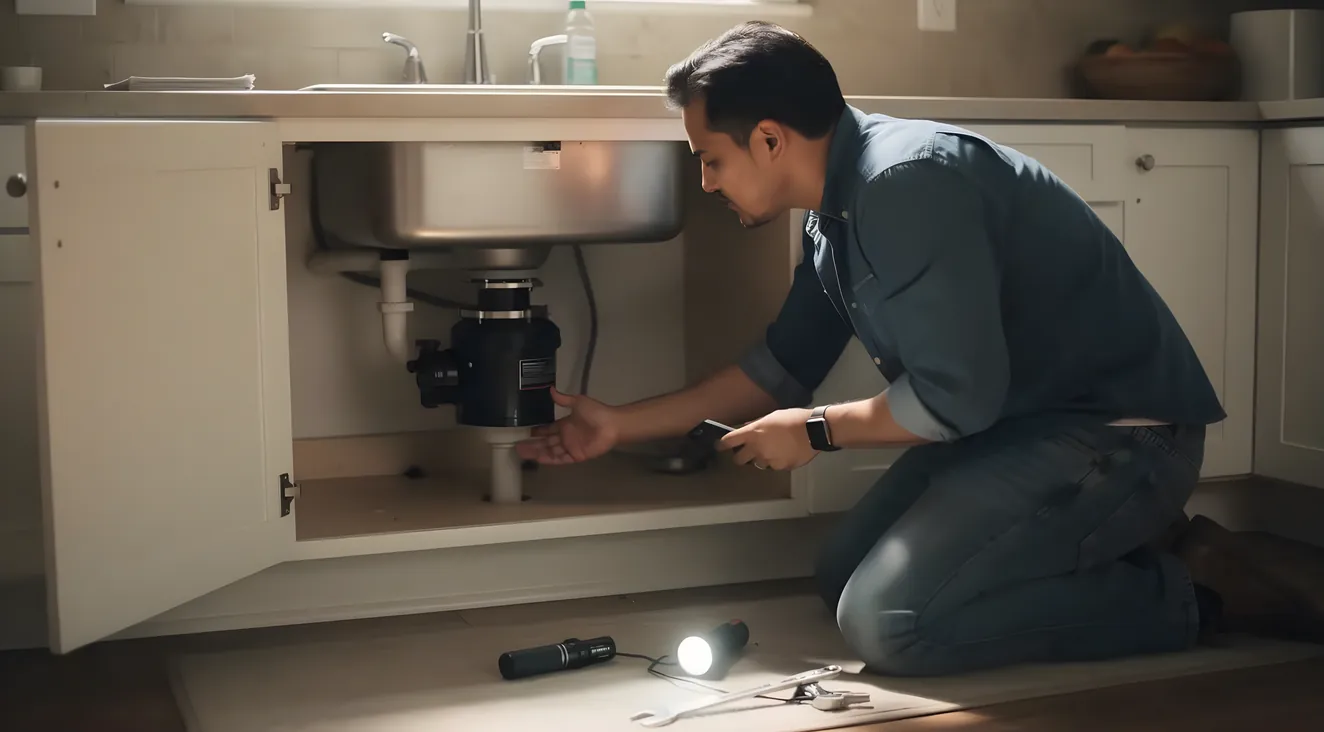
Here’s the part most people get wrong first: the disposal doesn’t have a spinning blade. What spins is an impeller plate, and it throws food waste outward against a stationary ring called the grind ring. That’s why almost every jam has the same fix. If the plate is blocked, the unit hums instead of spinning. If it already ground the waste fine and the sink still won’t drain, the problem moved downstream to the P-trap, and the disposal itself is innocent.
Two tools handle most of what goes wrong here: a 1/4-inch hex key (also called an Allen wrench) and the reset button on the underside of the unit. Between the two, you can clear a jam, reset a thermal trip, and be back to normal in under five minutes.
The dividing line between DIY and calling a plumber is just as simple. If the fix is mechanical (clearing a jam, pressing reset, tightening a hose clamp) or electrical up through the reset button, it’s a job you can do yourself with tools you probably already own. If the fix means opening the sealed motor housing itself (a failed internal seal, a burned-out motor, worn bearings), that’s a replace-or-call-a-pro situation. Nobody’s getting in there themselves.
Steps vary slightly by brand. Whirlpool, Frigidaire, and KitchenAid place the reset button and hex socket a bit differently, but the mechanism is the same across all of them, InSinkErator included.
This post walks through the seven problems I hear about most: humming but not spinning, no power at all, a reset button that won’t hold, leaks, a sink that won’t drain, bad smells, and noises that mean something is actually wrong. Find yours below and skip straight to it.
Humming but Won’t Spin (Jammed Disposal)
If your disposal is humming but won’t spin, that’s not a dead motor. It’s a jam, and the fix is a 1/4-inch hex key, not a service call. The motor has power and is trying to turn, but the impeller plate is physically blocked, so it keeps drawing current against that resistance. That’s where the hum comes from.
The One Rule That Applies to Every Fix in This Post
Whatever you're diagnosing, never reach into the disposal with your fingers, not even after you've confirmed the power is off. Tongs or pliers only. If your hand is going anywhere near the opening, kill power at the wall switch and flip the breaker too. That single habit matters more than any single fix in this post.
Usually the culprit is a hard object that fell in: a spoon, a bottle cap, a fruit pit, occasionally a piece of glass. Fibrous food (celery strings, corn husks) wraps around the plate and jams it just as effectively as a solid object does.
Here’s the fix, in order:
- Kill power at the wall switch, and flip the breaker too if you’re going to put your hand anywhere near the opening.
- Shine a flashlight down into the unit. If you can see the object, pull it out with tongs or pliers. Never your fingers, not even with the power confirmed off. That’s the one safety rule in this post.
- Find the hex socket in the bottom-center of the unit, underneath the sink, and insert a 1/4-inch hex key. Rotate it a full 360 degrees in both directions until it turns freely. That motion frees the impeller plate from whatever’s pinning it. InSinkErator, the brand most people have under their sink, ships this exact tool with new units and calls it a Jam Buster Wrench, though any standard 1/4-inch hex key does the same job.
- Restore power and press the reset button (more on that next).
If you hear the disposal humming, stop running it. Letting a jammed motor keep straining against the blockage is how a five-minute fix turns into a burned-out motor.
Won’t Turn On at All (No Power)
If the disposal is completely silent, no hum, no click, nothing, that’s a different problem than a jam. Work through the power chain in this order, because that’s the order that finds the actual fault fastest:
- Wall switch. Obvious, but confirm it’s on and isn’t itself the failure point.
- GFCI outlet. This is the step people skip. Plug another appliance (a hair dryer, a lamp) into the same outlet the disposal runs on. If that doesn’t power up either, the GFCI has tripped and needs resetting at the outlet. Plenty of kitchen circuits are GFCI-protected even without an obvious test-and-reset outlet, so don’t rule it out just because you don’t see one.
- Main breaker. Check the panel. A disposal pulling a stalled load can trip a breaker the same as any other appliance.
- The disposal’s own reset button, on the underside of the unit.
If you’ve checked all four and the unit is still completely dead, that points to a motor fault or an internal wiring problem. That’s past what a hex key and a reset button can fix, and it’s professional territory from here.
Reset Button Keeps Tripping
The reset button isn’t broken when it pops out. It’s doing its job, the same way a breaker trips before something burns. InSinkErator’s own reset instructions describe it as a thermal overload protector: when the motor draws too much current for too long, usually because it’s straining against a jam, the button trips to shut the motor down before it cooks itself.
The order matters. Kill power, clear whatever’s actually causing the overload (the hex key sequence from the section above), then press reset. Pushing reset back in without clearing the cause first just trips it again, or worse, keeps straining a motor that’s already been asked to work too hard.
If you’ve fully cleared a jam and the reset button still won’t hold, that’s not a jam problem anymore. That points to a failing motor, and at that point you’re looking at installing a new garbage disposal rather than repairing this one.
Leaking From the Top, Side, or Bottom
Where the leak is tells you what’s wrong. There are three zones, and they don’t share a fix.
| Leak Location | What’s Happening | The Fix |
|---|---|---|
| Top (sink flange, where it meets the disposal body) | A worn plumber’s putty seal or a failed gasket at the mounting ring | Tighten the mounting bolts first. If that doesn’t stop it, the gasket needs replacing. |
| Side (dishwasher inlet hose or drain discharge pipe) | A loose or worn hose clamp, or a weeping slip nut at the drain pipe connection | Tighten the clamp, or replace it if the rubber’s cracked. Same logic for the slip nut. |
| Bottom (the unit’s motor housing) | The internal seal around the motor shaft has failed. The motor housing is sealed at the factory, so you can’t open it, tighten it, or reseal it. | Not a repair job. This one’s a replacement. |
A bottom leak is the one that ends the conversation. Top and side leaks are usually a five-minute job with a wrench or a new hose clamp.
Running Fine but Water Won’t Drain
If the disposal runs normally (spins, sounds right, grinds whatever you put down there) but the sink still backs up, the disposal isn’t the problem. It already did its job. The blockage is downstream, in the P-trap, the curved pipe under the sink that traps a little standing water.
Two quick fixes worth trying first:
- Baking soda and vinegar down the drain, let it sit a few minutes, then flush with hot water.
- A plunger over the drain opening (cover the dishwasher air gap or the second sink drain first, or you’ll just push water sideways instead of through the clog).
If neither clears it, the next step is opening the P-trap itself, which means a bucket, slip nuts, and getting your hands wet. That’s beyond what this post covers. My full disposal repair walkthrough has the whole process, bucket placement and all, if you need to go that far.
Quick Self-Check: Is It the Disposal or the Drain?
It's the disposal
Humming without spinning, no power at all, a reset button that won't hold, a leak, or a squeal or grind coming from the unit itself.
It's the drain (P-trap)
The disposal spins and sounds normal, but the sink still backs up. The clog is downstream, not in the unit.
Foul Odor From the Drain
A bad smell doesn’t mean the unit is broken. Worth saying plainly, since this is the one symptom that worries people for no mechanical reason. Odor almost always means trapped food residue, not a failing part.
Run ice cubes and a handful of coarse salt through the disposal with cold water running. The ice knocks loose buildup on the impeller plate and grind ring, and the salt scrubs it out as it grinds. Baking soda and vinegar works too, the same combination used on drain clogs above.
One caution: skip concentrated lemon or citrus juice as a regular cleaning routine. The acid can affect the components with repeated use over time. Tossing in citrus peels once in a while is fine. It’s constant acid exposure that’s the issue, not an occasional peel.
Loud Grinding, Rattling, or Squealing Noise
Two different noises here, and they mean two very different things.
Grinding or rattling is usually the same story as the humming jam above: a foreign object caught against the impeller plate. Same fix applies: kill power, flashlight, tongs to pull out what you can see, hex key through the bottom socket to free the rest.
Squealing is the one to pay attention to. Not humming, squealing: a higher-pitched sound, not just something bouncing around in there. InSinkErator’s own noise-diagnosis guidance points to the same thing I’ve found true in practice: that sound means failing motor bearings, not a jam.
If your unit starts squealing, stop using it. The manufacturer guidance here is consistent: shut it down rather than keep running it, because continued operation on worn bearings turns a repairable fault into a fully dead motor. A jam costs you five minutes with a hex key. A burned-out motor from ignoring a squeal costs you the whole unit.
Two Sounds, Two Very Different Problems
Grinding or rattling
Something is caught on the impeller plate. Same fix as a jam: power off, flashlight, tongs for what you can reach, hex key for the rest.
Squealing
A higher-pitched sound that points to worn motor bearings, not an object stuck inside. Stop using the unit and start thinking about a replacement.
DIY Fix or Call a Plumber?
Here’s the honest version, no upsell attached, because there’s nothing to sell here.
| You Can Do This Yourself | Call a Plumber, or Plan to Replace |
|---|---|
|
|
Nothing on the left needs a professional, and nothing on the right is worth attempting yourself, since each one means opening a sealed motor housing you can’t put back together. I’m not going to tell you to trust the pros or push you toward calling anyone. This site doesn’t sell disposal repair. It’s just the honest line, so you can stop guessing and either grab the hex key or start looking at a replacement.
Garbage Disposal Troubleshooting FAQ
How do I reset a garbage disposal?
Start by cutting power at the switch or breaker. If the disposal was jammed rather than just tripped, work the hex key sequence first, rotating it through the bottom socket until the unit spins freely, since pressing reset before clearing the jam won’t hold. Once it’s clear, find the red button on the unit’s underside and press until it clicks, then restore power.
How do I reset a garbage disposal that’s humming?
Humming means jammed, not simply tripped, so the reset button alone does nothing here. Cut the power, locate whatever’s blocking the plate with a flashlight and pull it free with tongs, then work the hex key through a full rotation in the bottom socket. Only after that’s done should you press reset and switch the power back on.
How do I know if my garbage disposal motor is burned out?
Listen for the sound. A squeal instead of a hum is the giveaway, since that points to bearings wearing out rather than something stuck. Another sign: you’ve worked through the full jam-clearing steps, given the motor time to cool, and the reset button still won’t stay in, or the unit stays dead after you’ve already ruled out the switch, the GFCI, and the breaker.
What is the main reason a garbage disposal stops working?
Nine times out of ten it’s somewhere in the power path rather than the unit itself. Work it in order: the wall switch, the GFCI outlet (the step people forget to check), the main breaker, then the reset button on the disposal. Running through those four turns up the actual cause before you need to touch a tool.
Keep It From Jamming Again
Run cold water, not hot, during and after grinding. Hot water melts fat and grease, but that fat re-solidifies further down the pipe and becomes tomorrow’s clog. Cold water keeps it solid enough to flush straight through.
Skip fibrous stuff on purpose: celery strings, corn husks, onion skins. They wrap around the impeller plate instead of grinding cleanly, the same mechanism behind most jams above. And eggshells aren’t the sharpening trick some people swear by. The membrane inside the shell wraps the plate just like fibrous food does. It doesn’t sharpen anything, because there’s nothing to sharpen.
If your disposal keeps giving you trouble and you’re leaning toward replacing it rather than fighting the same jam every month, start with picking a new disposal before you buy the first one you see at the hardware store.