
Two winters into owning this house, the guest room above the garage got cold enough that nobody wanted to sleep in it. I blamed a drafty window until a home inspector, in for an unrelated refinance appraisal, flagged the attic insulation as “original to the house, estimated 20-plus years old.” That sent me up with a flashlight instead of trusting a stranger’s guess.
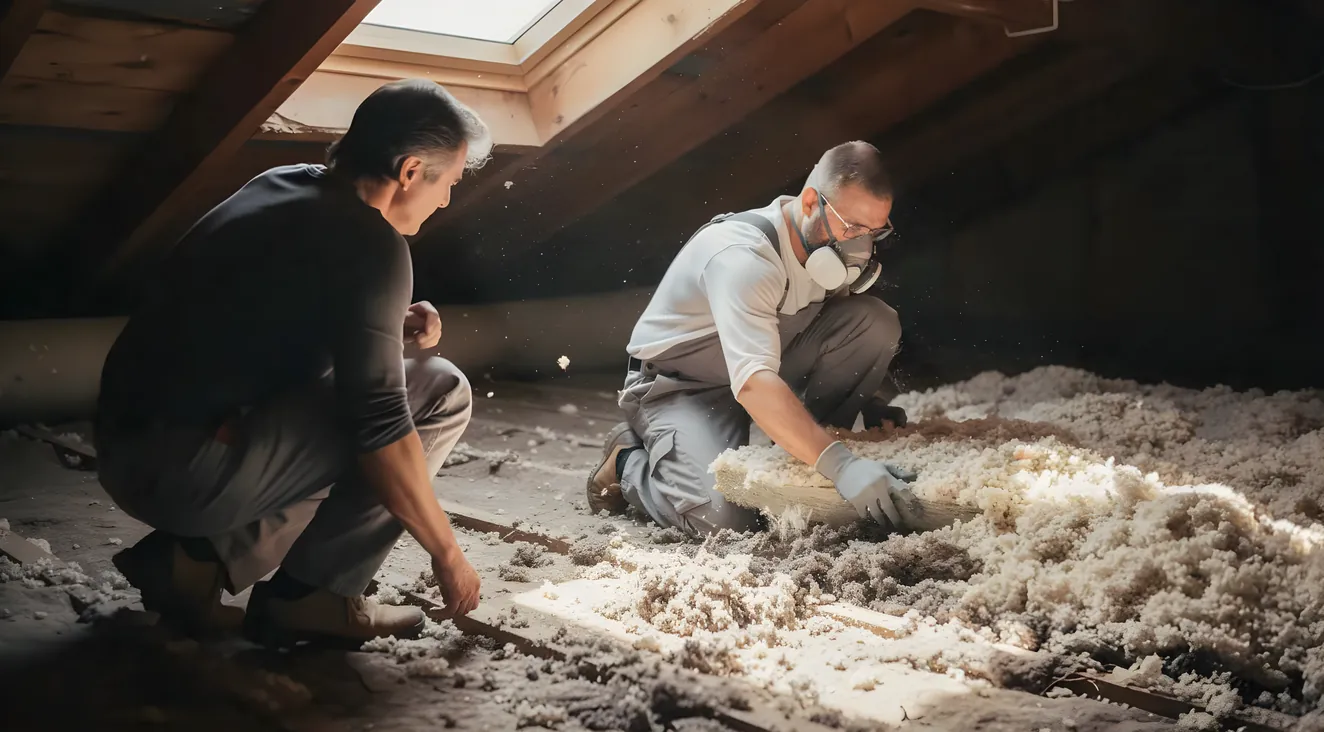
Here’s what climbing up there taught me: attic insulation gets replaced when it’s wet, moldy, pest-contaminated, or badly compressed, not on a fixed age. Insulation that’s just thin but otherwise clean and dry gets topped off instead, which is cheaper and faster.
That holds because four separate things wreck attic insulation, and they don’t run on the same clock. Settling flattens loose-fill insulation under its own weight. Moisture soaks it and never fully bounces back. Pests tunnel through it and contaminate it. Wind washing quietly strips the still-air layer that gives insulation its R-value, right at the eaves, often with no visible sign anything’s wrong. Nobody publishes a hard “replace by year X” number for any of this. The 15-to-30-year range you’ll see quoted is practitioner consensus, not a government standard. What decides it is what you actually find up there.
Why “How Old Is It” Is the Wrong First Question
The number on a bag of insulation is a lab result, not a warranty. Manufacturers measure R-value at a fixed indoor-to-outdoor temperature difference, in a controlled chamber, on a fresh sample. That’s the nominal R-value, not the installed, aged R-value your attic actually has years later, and it says almost nothing about what that same material is doing up there.
Three separate mechanisms erode that number: settling (the material compacts and loses loft), moisture (water displaces the trapped air the insulation depends on), and wind washing (air movement strips the still-air layer off the surface). Each works independently, and none of them shows up on the bag.
Oak Ridge National Laboratory’s attic-chamber testing (the Wilkes and Childs study) measured this directly: loose-fill insulation’s real R-value dropped as outdoor temperatures fell, because convective loops formed inside the material at large temperature differentials, a mechanism the lab-rated nominal number never captures.
So the real question isn’t how old your attic insulation is. It’s whether it’s still dry, uncompressed, and free of pests, because those three things decide whether you top it off or tear it out.
How I Actually Checked My Attic (Flashlight, Tape Measure, Fifteen Minutes)
I brought up a flashlight, a tape measure, an N95 mask, and clothes I didn’t mind throwing straight in the wash. The whole attic inspection took about fifteen minutes.
First, depth against the joists. Where the tops of the joists were still visible above the insulation, I was under target for my climate zone. Where the insulation buried them completely, depth probably wasn’t the problem. I checked three or four spots, since real attics are rarely even.
Then I checked what the material actually was: blown-in fiberglass, roughly R-3.1 to R-3.2 per inch (cellulose runs closer to R-3.5, a rough field conversion, not a lab figure). Inches times that number gave me a ballpark R-value to compare against a target.
Next, compression. Insulation doing its job has loft and springs back under a hand. Mine, near the attic hatch where foot traffic had flattened it, stayed flat.
Then moisture: dark streaks, matted clumps, or a musty smell, different from ordinary dust discoloration, which just looks gray or brown with no odor. I found none.
Last, pests: droppings, shredded material, or tunneling, checked closely at the eaves and corners, where rodents tend to travel. One more thing worth knowing: a dark, dusty streak in the insulation itself often marks where air has been leaking through from below, a widely used building-science diagnostic for finding leaks before you insulate over them.
The fifteen-minute check, at a glance
Depth: joist tops visible = under target for your zone
Material: fiberglass ~R-3.1-3.2/in, cellulose ~R-3.5/in
Compression: should spring back under a hand, not stay flat
Moisture: dark streaks, matted clumps, or a musty smell
Pests: droppings, shredded material, tunneling near eaves and corners
The Four Things That Actually Wreck Attic Insulation
Settling. Loose-fill cellulose has the highest documented settling rate of the common attic materials: 13 to 20 percent after installation, mostly within the first few weeks. That’s why the Federal Trade Commission’s (FTC) R-value Rule (16 CFR Part 460) requires bags to disclose a minimum settled thickness rather than a fresh-out-of-the-bag number, and why installers commonly overfill by roughly 20 percent to compensate. Blown fiberglass settles less. Contractor and vendor sources put that figure around 3 to 5 percent over 20 to 30 years, a directional estimate from industry blogs, not a government study.
Before you climb up: know what you're not allowed to touch
If your house was built before roughly 1990, there's one material that ends the DIY plan the moment you see it: a pebbly, accordion-shaped, gray-brown insulation called vermiculite. It's easy to mistake for something you can just add over. Don't disturb it, don't bag it, don't vacuum it. A meaningful share of vermiculite from that era carries asbestos, and identifying it is the one step worth doing before any of the walkthrough below, not after.
Moisture. Water displaces the trapped-air layer insulation depends on to slow heat flow, and that layer doesn’t fully return once the material dries. This is a separate problem from mold, and it matters even when mold never grows: a roof leak, an ice dam, or a bathroom fan duct venting into the attic instead of outside can ruin performance with no visible mold at all. When mold does show up, the EPA’s guidance on porous materials is unambiguous: mold-contaminated insulation is nearly impossible to clean thoroughly, so the standard recommendation is removal and replacement, not treatment in place.
Pests. Rodents don’t just nest in insulation. They tunnel through it, shred it for nesting material, compress it along their travel paths, and leave droppings and urine that soak into the fibers. Once that’s happened, the material fails the same test the EPA applies to moldy insulation: porous material that’s absorbed contamination doesn’t get cleaned, it gets replaced.
Wind washing. Moving air at the soffit vents or through gaps at the eaves strips the still-air layer the R-value depends on, and it’s the failure mode almost nobody talks about. Building-science trade publications (Energy Vanguard and the Building Performance Association Journal, not a government source) report that leaving just 1 percent of an attic uninsulated can drag the average R-value down by roughly 27 percent. Wind washing at the eaves can strip half the rated R-value from loose-fill insulation without a single visible sign of age or damage.
Each points to a different verdict:
- Settling and thinness alone usually mean top it off.
- Moisture and pests mean tear it out, regardless of how new the material looks.
- Wind washing means the fix might be sealing the eaves before touching the insulation at all.
How Long Fiberglass, Cellulose, and Spray Foam Actually Last
No government agency publishes a chart for how many years insulation is good for. That gap is real, and the ranges below come from contractors and building-science writers, not a lab or a federal standard.
| Material | Realistic performance window | Note |
|---|---|---|
| Fiberglass batts/blown | 15-30 years | Manufacturer claims of 80-100 years describe material durability, not real-attic performance |
| Cellulose | 15-30 years | May need topping up after 10-15 years due to settling, even before full replacement is warranted |
| Spray foam (closed-cell) | 50+ years, properly installed | Not immune to roof leaks or a bad installation job |
The fiberglass range is worth pausing on. A lot of the “replace at 15 years” advice online comes from companies that sell replacement insulation, a real conflict of interest worth knowing before taking that number at face value. Under good conditions (dry, undisturbed, properly ventilated), fiberglass and cellulose both realistically perform for 15 to 30 years. Spray foam doesn’t settle the way loose-fill does, which is most of why it holds up longer, but amateur installation or a slow roof leak can shorten its life regardless of the material’s theoretical ceiling.
None of these numbers are a countdown clock. They’re a prompt to go check, using the same walkthrough above, not a date to circle on the calendar.
Top Off or Tear Out: The Call I Made
Here’s the dividing line, stated plainly: top off when the existing material is dry, uncompressed, free of mold and pests, and the only issue is thinness relative to your climate zone’s target. Full replace when there’s water damage, visible mold, pest contamination, or air-sealing work underneath that means pulling insulation back anyway.
Most guides treat material type, age, and condition as three separate questions. They’re one decision. Fiberglass in for 20-plus years, flat and thin with no staining or droppings, is a top-off. Staining or droppings from the walkthrough above make it a tear-out regardless of how old or good-looking the material is otherwise.
Check your depth against the U.S. Department of Energy (DOE) and ENERGY STAR’s recommendation for existing homes, roughly R-30 to R-49 in southern climates and R-49 to R-60 in northern climates, looked up by ZIP code through energystar.gov’s DIY Checks tool, not the building code. That’s a different figure from the International Energy Conservation Code’s (IECC) code minimum for new construction, and conflating the two is one of the most common mistakes on this topic. The IECC minimum has moved twice recently: the 2021 edition raised ceiling R-values by roughly one tier, and the 2024 edition rolled much of that back, by roughly R-11 in the zones affected most. Which edition applies depends on local adoption, and it’s a legal floor for new construction, not a target for an existing attic.
My attic: 20-year-old fiberglass, six-plus inches, no staining, no droppings, no compression outside the hatch area. Dry and clean, just short of the DOE/ENERGY STAR target for my zone. That’s a top-off. Staining or pest sign instead, and the depth reading wouldn’t have mattered.
Top off, or tear out?
Top off when:
Material is dry, uncompressed, free of mold and pests, and the only issue is thinness for your climate zone.
Full replace when:
There's water damage, visible mold, pest contamination, or you need to pull insulation back to air-seal underneath anyway.
What It Actually Costs Either Way
These are contractor-estimate averages, not fixed prices. They shift with region, attic size, and access, so treat them as a conversation starter, not a quote.
Topping off: according to HomeGuide’s attic insulation cost breakdown, adding more insulation to an existing attic runs $1 to $4 per square foot with professional installation, depending on the existing insulation, type, and desired R-value, which works out to roughly $1,000 to $4,000 for an average-sized attic. Treat that as a rough range, not a quote.
Full replacement: according to HomeGuide’s attic insulation cost breakdown, figure roughly $2 to $6 per square foot, which includes $1 to $2 per square foot for removing and disposing of the old material before new insulation goes in.
Removal only, if you plan to install new material yourself afterward: the same HomeGuide data puts that around $600 to $1,200.
The removal-and-disposal step is what makes a full tear-out cost meaningfully more than a top-off. That’s part of why the call in the last section matters for your budget, not just for how the insulation performs once it’s done.
When This Stops Being a DIY Job
There’s one material that takes this whole project out of DIY territory entirely: vermiculite. If your house was built before roughly 1990 and you find a pebbly, accordion-shaped, gray-brown material instead of fluffy fiberglass or cellulose, don’t touch it, don’t disturb it, and don’t try to remove it yourself. A meaningful share of vermiculite installed in that era carries asbestos contamination, and the health risk isn’t worth guessing about. The right move is hiring an accredited asbestos abatement contractor, separate from whoever does the actual insulation work afterward.
A few other triggers push this past a weekend project even without vermiculite in the picture:
- Duct leaks running through the attic mean the HVAC system is losing conditioned air into unconditioned space, worth a professional look before insulating over it.
- Structural rot in the roof deck or rafters needs fixing before new insulation goes in, not burying under it.
- Ceiling damage from long-term moisture needs the same treatment: fix it first, insulate after.
FAQ Section
How do I know if my attic insulation needs to be replaced?
Press on it: does it bounce back, or stay flattened? Check for a musty smell, staining, droppings, or tunnels. Any one of those last three means replace, regardless of age. Flatness alone, with everything else dry and clean, usually just means it’s time to add more.
What is the 7 and 7 rule for attics?
This phrase shows up in search suggestions, but it doesn’t trace back to one consistent, sourced definition anywhere across building-science or insulation-industry sources I found. Rather than guess, use the depth and condition check above instead: measure against the joists, check for moisture and pests, and let those results decide.
Is it worth replacing attic insulation?
Yes, when the material is wet, moldy, pest-contaminated, or crushed flat, since those conditions hurt comfort and energy bills regardless of age. If it’s simply thin but otherwise sound, topping off gets most of the benefit for a fraction of the cost.
Is it better to remove old attic insulation before adding new?
Only if it’s contaminated, in which case there isn’t much choice, or if you need to get underneath it to air-seal the ceiling plane first. Otherwise, dry and intact insulation can be built on top of directly.
How much does it cost to insulate a 2,000 square foot attic?
Depends on whether you’re topping off or tearing out. A typical top-off runs $1 to $4 per square foot with professional installation, per HomeGuide’s cost data; a full tear-out and replace runs closer to $2 to $6 per square foot including removal, per HomeGuide. Actual numbers move with your market.
How often do you replace your attic insulation?
There’s no set interval to circle on a calendar. Most fiberglass and cellulose keep performing acceptably in a 15-to-30-year window under dry, undisturbed conditions, but that’s practitioner experience, not a government schedule. Age is a cue to go check, condition decides the rest.
What I’d Check Before Next Winter
New insulation over a leaky ceiling plane still underperforms, so air sealing is the step that’s easy to skip and expensive to skip. Recessed lights, plumbing stacks, the attic hatch itself: those gaps let conditioned air escape straight past whatever R-value you just added. I sealed what I could reach the same weekend, and it’s worth doing before insulation goes down, not after.
Beyond that, I’m planning to climb back up with the same flashlight once a year, probably in early fall before the weather turns, since that beats spotting problems mid cold-snap.
If you’re wondering whether any of this actually helps once the temperature climbs instead of drops, that’s a separate question I get into here: does attic insulation help in the summer?. And if you want more of what I’ve fixed around the house, that’s what the rest of homerous.com is for.