
Drain flies breed in the biofilm coating the inside of your pipes, not in standing water. That single fact explains almost everything else about this problem. Biofilm is the sticky, gel-like layer of bacteria, grease, hair, and soap residue that builds up on the walls of a slow or rarely-used drain, and it’s exactly where a female drain fly lays her eggs.
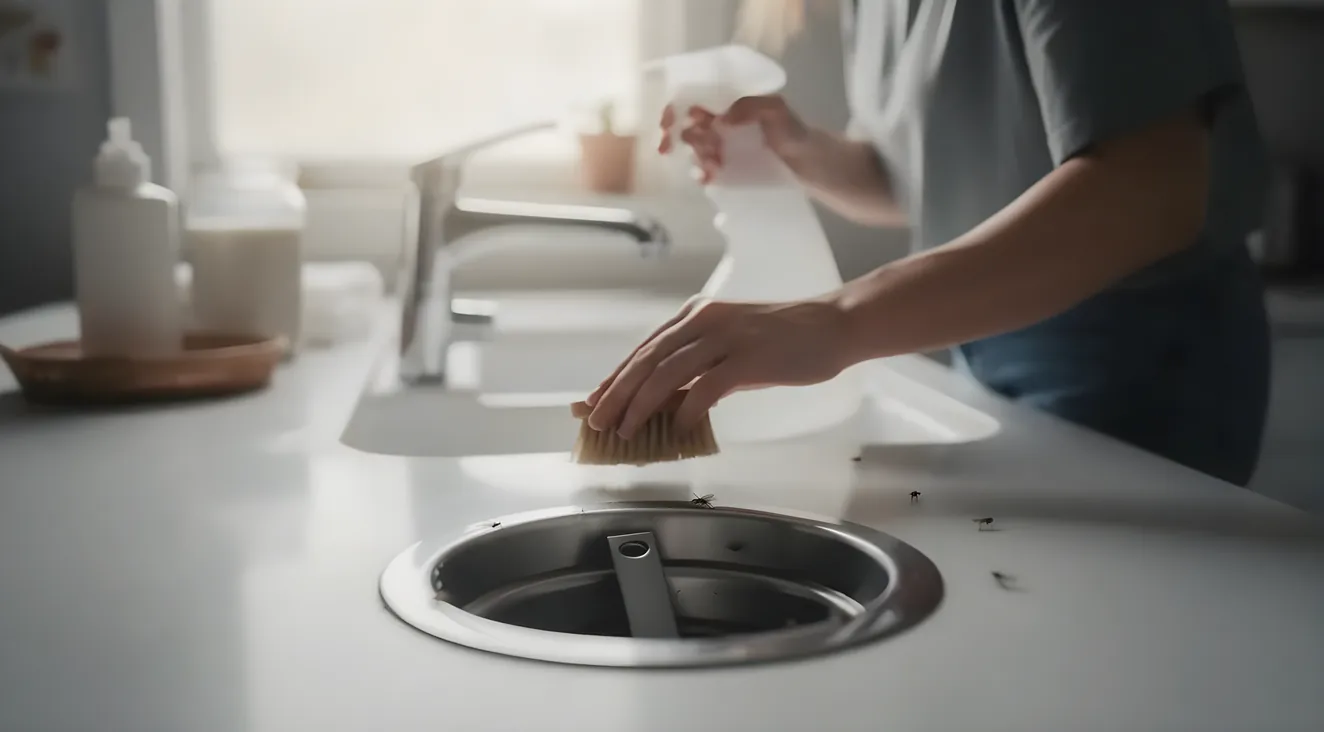
That’s also why pouring bleach or boiling water down the drain kills the flies you can see and almost never solves the problem. The eggs and larvae are packed into that film, shielded from whatever you pour past them, and a new batch of adults hatches out within days.
What actually works is a two-part job: scrub the inside of the pipe with a brush to physically remove the film, then follow up with an enzymatic drain cleaner that keeps digesting what the brush missed. Trap the adults you can still see with a separate vinegar-and-dish-soap trap while that treatment works. And give it time. University of Arkansas Cooperative Extension puts real control at a minimum of three weeks of cleaning and follow-up, not a one-time fix.
Before any of that, it’s worth confirming what you’re actually looking at. Drain flies are fuzzy and moth-like with tented wings. Fruit flies are smooth-bodied with visible red eyes. Fungus gnats are slender and come from houseplant soil, not your sink. Treating the wrong pest is the fastest way to waste a weekend.
Is It Actually a Drain Fly? (Fruit Flies and Fungus Gnats Get Blamed a Lot)
I want to get this out of the way first, because I spent a week fighting the wrong bug before I looked closely at what was actually hovering over my bathroom sink.
Drain flies are small, dark, and covered head to wingtip in fine hair, which gives them a fuzzy, almost moth-like look. At rest, they hold their wings tented over their body like a little roof. That’s the tell I’d use if I could only pick one. They don’t fly well either; they tend to hop and flutter short distances rather than zip around a room.
Fruit flies, the common name for flies in the genus Drosophila, are the pest most people blame instead, and it’s an easy mix-up since both show up near sinks. Fruit flies have a smooth, shiny body and visible red eyes, and they hold their wings flat against their back instead of tented. They also cluster around ripening produce, recycling, and sticky spills as much as they cluster around a drain, which drain flies don’t do. If you clear out the fruit bowl and the flies vanish, you had fruit flies.
Fungus gnats are the third suspect, and location gives them away more than looks do. They’re slender with long dangling legs, more like a tiny mosquito than a moth, and they breed in overwatered potting soil. If the flies are hovering around a houseplant and not your plumbing, let the soil dry out before you touch a single drain.
One more you might run into: phorid flies, which have a distinctly humped back and run across a counter instead of flying off when you swat at them. They breed in the same kind of drain gunk drain flies do, so the fix barely changes even if you’ve got the ID wrong.
| Pest | Body | Wings at rest | Where you find them |
|---|---|---|---|
| Drain fly | Fuzzy, moth-like | Tented, roof-shaped | Hovering right at the drain opening |
| Fruit fly | Smooth, red eyes | Flat against body | Around produce, recycling, spills |
| Fungus gnat | Slender, small dark eyes | Flat, mosquito-like | Over houseplant soil |
Why Bleach, Vinegar, and Boiling Water Alone Don’t Clear an Infestation
I poured a whole bottle of bleach down my bathroom sink the first week and felt pretty good about myself. Three days later, the flies were back. This is the part nobody selling you a drain cleaner explains well.
Bacteria colonize the inside of any drain that runs slow, stays warm, and carries a steady diet of hair, grease, soap scum, and skin cells. They secrete a sticky matrix that lets them stick to the pipe wall and to each other, and that’s your biofilm: a coating, not a puddle. Drain fly larvae live and feed right inside that coating, breathing through a little tube they poke up to the surface. The film itself protects them from anything you pour down the drain in passing.
Ohio State University’s College of Food, Agricultural, and Environmental Sciences (CFAES) says it plainly in its drain fly fact sheet: “the use of bleach does not seem to rid pipes of the scum, and the drain fly larvae are surprisingly resistant to bleach.” That line comes from a university entomology fact sheet, not an ad, and it matches what I actually experienced.
Boiling water is where sources genuinely disagree, and I’d rather tell you that than pretend it’s settled. Ohio State CFAES and Clemson University’s Home & Garden Information Center both list very hot water as part of an effective routine, paired with brushing. Alabama Cooperative Extension System lists boiling water among the treatments that don’t work poured down a drain by itself. My read: boiling water loses most of its heat traveling through room-temperature pipe before it ever reaches an established biofilm layer, which lines up with Alabama’s “doesn’t work alone” finding. It’s still useful as a rinse while you’re actively scrubbing, just don’t expect a kettle of hot water on its own to finish the job.
Baking soda and vinegar, probably the most common drain fly home remedy people reach for, gets the same treatment in my house now: I still use it, because the fizzing does loosen surface grime, but there’s no evidence it dissolves the biofilm itself or does anything to the larvae living inside it. Treat it as a helper, not a cure.
One safety note that matters more than any of the above: never mix bleach with a caustic drain cleaner or an ammonia-based product. Ohio State CFAES specifically warns that combination can release chlorine gas, and that’s true in your bathroom sink the same way it’s true anywhere else.
Does It Actually Work? A Fast Read on the Common Fixes
Bleach
Doesn't work. Larvae are resistant, film stays intact.
Boiling water
Disputed. Useful as a rinse while scrubbing, not a fix alone.
Vinegar and baking soda
Loosens surface grime only. Doesn't touch the biofilm or larvae.
Brush plus enzyme cleaner
Actually works. Removes the film and keeps digesting what's left.
Find the Drain That’s Actually Breeding Them
Drain flies can breed in almost any drain in the house:
- Sink and shower drains
- Floor drains, especially in basements and laundry rooms
- Garbage disposals
- Toilet bases
- AC or refrigerator condensate pans
But the classic source, over and over in the research and in my own house, is a drain that barely gets used.
Nothing flushes the biofilm out of a drain nobody runs water through, so the film just keeps building.
The practical test I used: if you’re only seeing flies in one room, the source is almost certainly a drain in that room. Check everything, not just the obvious sink. I found mine in a guest bathroom that gets used maybe twice a month, and I only found it because I checked every drain in that room, including the floor drain I’d forgotten was even there.
I’ll admit the specific trick I used to confirm it, taping a clear cup over a suspect drain overnight to see if anything got trapped inside, isn’t something I can point you to a university source for. It’s just what worked for me, so take it as one homeowner’s method, not a verified extension technique.
What's a P-Trap?
The curved section of pipe under a sink or floor drain that holds a little standing water on purpose. That water forms a seal against sewer gas coming back up into the room. A drain that goes weeks without use can let that seal evaporate, opening a clear path for sewer gas, and the flies breeding further down the line, to come up into your house.
The Drain Fly Life Cycle, and Why You’ll Still See a Few for a While
This is the part that would have saved me from panicking. A drain fly’s full life cycle, egg to adult, takes roughly one to three weeks depending on temperature, per Ohio State CFAES, with the University of Florida IFAS putting the more common range at 21 to 27 days under normal household conditions. Eggs hatch in under two days, so an active breeding site keeps pumping out new adults even after you’ve started cleaning.
Here’s the part that matters most for your sanity: adults that had already hatched before you touched the drain still have their whole lifespan left to run out. Extension sources mostly converge on about two weeks for an adult’s life, with some citing up to 20 days. So if you scrub the pipe and dose it with an enzyme cleaner today, seeing a handful of flies for one to two weeks afterward is expected. It doesn’t mean the treatment failed. It means you’re watching the last generation age out.
The bigger number, and the one I actually wish someone had told me on day one, comes from the University of Arkansas Cooperative Extension Service (UAEX): real control takes at least three weeks of cleaning and maintenance, not a single treatment. Most competing advice out there treats this like a one-and-done job. It isn’t, and knowing that up front will keep you from dumping more chemicals down the drain out of frustration in week two.
One honest flag: a commercial source I came across, Southland Organics, cites 300 eggs laid in 48 hours and an 8 to 24 day emergence window, numbers that don’t fully line up with the university figures above. I’m going with the extension sources (Ohio State, UF/IFAS, UAEX) as the more reliable citation here, since they’re academic rather than product-driven.
The Drain Fly Timeline
Egg to adult
1 to 3 weeks (Ohio State CFAES), commonly 21 to 27 days (UF/IFAS)
Adult lifespan
About 2 weeks, up to 20 days on some counts
Real control
At least 3 weeks of cleaning and follow-up (UAEX)
How to Actually Clear a Drain Fly Infestation
Here’s the process, in the order I actually did it.
- Scrub the pipe. Take a stiff pipe brush, or a bottle brush taped to a length of wire if that’s what you’ve got, and physically scrub as far down the drain as you can reach. This is the step that removes the biofilm itself instead of just poisoning whatever’s sitting on top of it, and it’s the one both Ohio State CFAES and UF/IFAS name as genuinely effective.
- Follow with an enzymatic drain cleaner. Pick a bio or enzyme-based cleaner rather than a caustic one. These use live bacteria and enzymes to keep digesting organic matter over several days rather than working in one shot, which is exactly what Ohio State’s fact sheet recommends as the pairing for mechanical scrubbing. Apply it on the schedule the label gives you, not just once.
- Trap the adults you can still see. Mix apple cider vinegar with a drop of dish soap in a shallow dish and leave it uncovered near the drain, or cover it with plastic wrap poked full of small holes. The vinegar’s smell pulls flies in, and the dish soap breaks the liquid’s surface tension so a fly that lands sinks instead of walking away. This doesn’t touch the biofilm, it just knocks down the annoying part while the real treatment works.
- Repeat. This isn’t a spray-and-forget job. Keep brushing and dosing the drain over the three-week window UAEX describes, and keep the vinegar trap fresh in the meantime.
That’s it. No specialty tools, no calling anyone, just the same brush, cleaner, and trap running on repeat until the three-week UAEX timeline plays out.
Keeping Them from Coming Back
Once the drain is actually clear, the fix is boring, which is the whole point. Alabama Cooperative Extension System recommends running water through rarely-used drains weekly, and that’s the one specific number worth remembering: a guest bathroom sink, a laundry floor drain, a basement floor drain, whatever in your house doesn’t see daily use. A minute of running water keeps the P-trap seal wet and flushes out film before it has a chance to build.
Fix leaking pipes and dripping faucets sooner rather than later, since a slow, steady drip is exactly the kind of low, warm moisture biofilm loves. Run your garbage disposal regularly and flush it with water after use instead of letting food scraps sit in the chamber. I couldn’t find a specific extension-backed cleaning schedule for disposals the way there is for unused drains, so I’m not going to invent one here. Regular use and a rinse after each use is the honest guidance.
When It’s More Than a Dirty Drain
Most of the time, this is exactly what it looks like: a drain that needs a scrub and a few weeks of follow-up. But there’s one signal worth taking seriously. If you’re smelling an actual sewage odor, not just a musty drain smell, and it keeps coming back after you clean, or the flies are showing up somewhere with no obvious drain nearby, that can point to a cracked sewer line, a failing septic line, or a dry trap letting sewer gas and flies up from further down the system. That’s the one situation where drain fly removal genuinely means calling a plumber, not running another round of enzyme cleaner.
If the pest problem you’re actually dealing with is rodents rather than flies, that’s a different job entirely; I’ve covered another common household pest problem separately.
Worth saying plainly: drain flies are a nuisance, not a health threat. They don’t bite and they aren’t known to spread disease. What they are is a sign that an organic film has built up somewhere in your plumbing, which is worth fixing for your drains and your nose, not because it says anything about how clean your house is. Even a well-kept home gets them from one guest bathroom nobody uses.
This is one of the jobs I’ve written up alongside the rest of the mechanical-repair posts on Homerous, and like most of them, it looks worse than it is once you understand what’s actually happening in the pipe.
Drain Fly FAQ
How do you permanently get rid of drain flies? There’s no single-application fix. Permanent control means repeating the scrub-and-enzyme routine above for the full window, at least three weeks per UAEX, not stopping after the first day the flies seem gone.
Why am I suddenly getting drain flies? Something changed in a drain’s normal use: it went unused for a while, started running slower than usual, or started collecting more grease or hair than it used to. A guest bathroom that suddenly sees more traffic, or a disposal that’s been running heavier meals through it, are common triggers.
What can I pour down my drain to get rid of them? An enzymatic or bio-based drain cleaner is the one pour-down-the-drain option with a real mechanism for reaching the biofilm itself. Bleach, vinegar, and boiling water can knock down what’s on the surface, but none of them reliably clear the film on their own.
Will Dawn dish soap kill drain flies? A drop of dish soap breaks the surface tension in an apple cider vinegar trap, so any fly that lands sinks instead of flying off. That kills flies that land in the trap. It does nothing for the biofilm that’s producing new ones.
What scent do drain flies hate? I couldn’t find any university or extension source documenting a scent that actually repels drain flies, so I’m not going to make one up. The apple cider vinegar trap works by drowning flies that land in it, not by scaring them off with a smell.
What kills drain flies immediately? Nothing takes care of the underlying infestation instantly. A spray or the vinegar trap kills the adults you can see on contact, but the larvae living in the biofilm need the full multi-week scrub-and-enzyme process described above.
Do drain flies eventually go away on their own? Only if whatever’s feeding the biofilm stops on its own, which is rare. A drain that gets heavier daily use, or one that happens to get cleaned for unrelated reasons, can starve the film out over time. Left alone, most breeding sites just keep producing new adults.
Are drain flies harmful? No. They’re a nuisance, not a hazard: no bite, no known disease transmission. Seeing them just means an organic film has built up somewhere in the plumbing, and that’s a maintenance issue, not a cleanliness verdict on your house. Plenty of tidy homes get a batch from a guest bathroom that only sees company twice a month.