
I’m standing at one of the double-hung windows in my own dining room right now, so let me give you the fastest answer first: a double-hung window has two sashes, an upper sash and a lower sash, and both slide vertically and lock independently. That’s what separates it from a single-hung window, which looks nearly identical from the outside but only lets the bottom sash move; the top one is fixed in place for good.
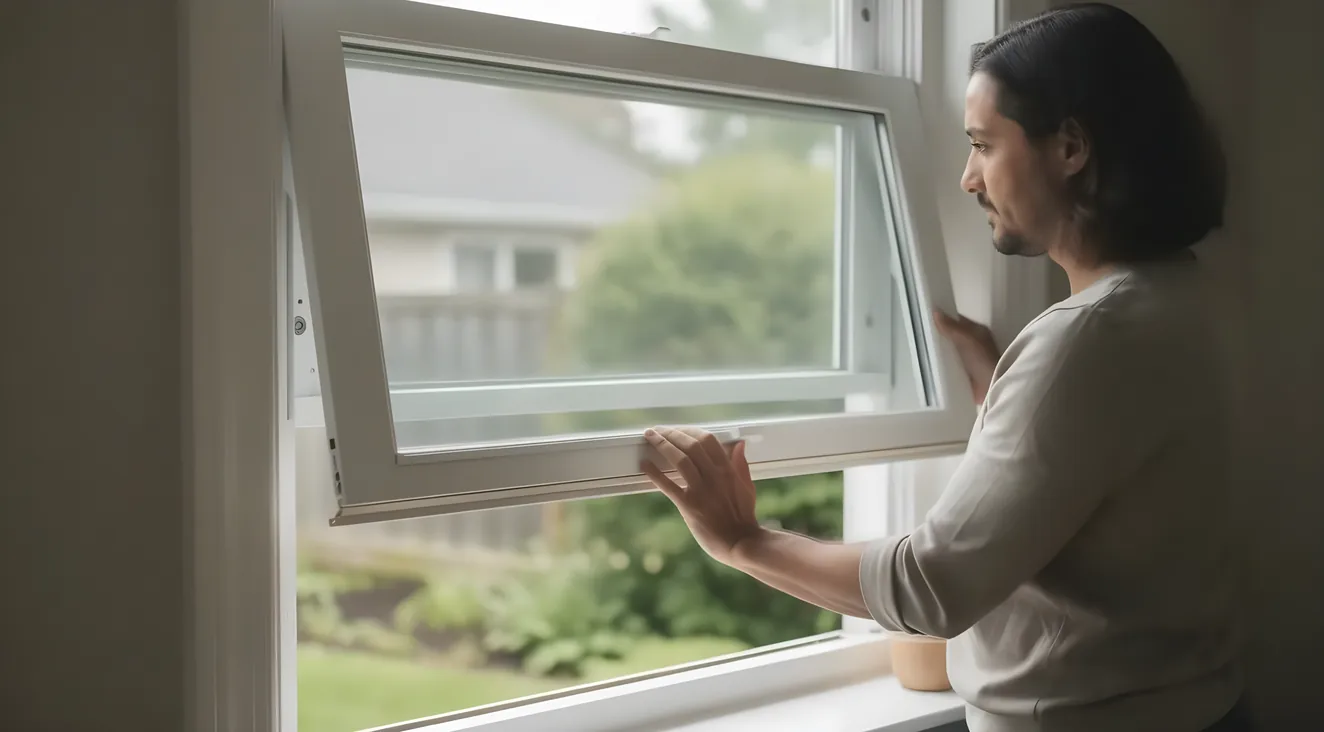
Each sash on a double-hung window rides on its own spring balance (or, on an older wood window, a rope-and-pulley counterweight), and that hardware is what lets a sash stay exactly where you leave it, six inches open, halfway up, all the way, without you propping it with a stick or a paperback. Because both sashes on a double-hung window are held in place by their own spring balance, you can drop the top sash a few inches for ventilation while leaving the bottom sash closed and out of reach of a kid or a dog. Most modern double-hung sashes also tilt in on small hinge pins so you can wash the outside glass from inside the house.
I’ve pulled a balance out of one of my own windows to figure out why a sash kept sliding shut on its own, and I’ll walk through what that repair actually involves toward the end of this piece. First, the parts, because most of the confusion about double-hung windows comes from people not having names for what they’re looking at.
The Parts of a Double-Hung Window (Sash, Meeting Rail, Balance, Jamb)
“Sash” is the moving frame that actually holds the glass, and every double-hung window has two of them stacked in the same opening: an upper sash and a lower sash. On most double-hung windows they’re the same size, though some traditional designs make the lower sash taller, since that’s the one people look and reach through most.
Where the bottom rail of the upper sash meets the top rail of the lower sash, when the window is fully closed, is called the meeting rail. Remember that term, because it comes back up later when I get into where a double-hung window actually loses air. It’s the one seam in the whole assembly that isn’t a continuous sealed track, which makes it the weak point.
The jamb is the vertical part of the window frame that the sashes ride up and down inside. Run your hand along either side of the opening and you’re touching the jamb. Hidden inside that jamb is the balance channel, a narrow cavity that houses either a modern spring or coil balance or, in an older wood window, a rope running over a pulley down to a concealed counterweight. You’ll probably never see the balance channel unless you’re doing a repair, but it’s doing more work than any part you can actually touch: it’s the reason the sash doesn’t just fall the second you let go of it.
Put those four together and you’ve got the whole mechanical picture: two sashes, meeting at the meeting rail when closed, riding in tracks cut into the jamb, each one counterbalanced by hardware hidden inside that same jamb. Every other section in this piece is really just an expansion on one of those four parts.
How to Tell If Your Window Is Single-Hung or Double-Hung
Here’s the problem: from the sidewalk, a single-hung window and a double-hung window look identical. Same two stacked sashes, same size, same grille pattern if it has one. The only way to actually tell them apart is to touch the window, not look at it. I use this three-step test any time I’m sizing up a house I don’t know:
The Verdict, at a Glance
Only the bottom sash moves
Single-hung window. The top sash is fixed no matter how hard you push.
Both sashes slide independently
Double-hung window. Either sash moves on its own, in either direction.
- Stand inside and put a hand flat on the top sash. Try to slide it down an inch or two.
- If the top sash doesn’t budge, put your hand on the bottom sash instead and try to slide it up.
- If only the bottom sash moves and the top one is locked solid no matter what, you’re looking at a single-hung window. If both sashes move independently of each other, it’s double-hung.
One thing that trips people up: a single-hung window’s top sash can look like it should move. It has the same hardware profile, sometimes even a fake meeting rail seam, but it’s fixed to the frame with screws or a permanent stop that isn’t going anywhere. Don’t trust the look of it, trust whether it actually slides when you put weight behind it.
If you’ve got a window painted shut, this test gets harder, since a stuck single-hung top sash and a stuck double-hung top sash can feel the same from the inside. In that case, check the exterior trim: double-hung windows almost always have a continuous track running the full height of the frame on both sides, while a single-hung window’s track for the fixed sash is sometimes shorter or blocked off, since it never needed to travel.
How the Balance Mechanism Holds Each Sash Open
The balance is the part of a double-hung window that does the actual work, and it’s also the part almost nobody explains, which is strange, since it’s the piece that fails first.
On an older wood double-hung window, the balance is a rope or chain running from the sash, up and over a pulley mounted at the top of the jamb, down to a cast-iron weight hidden inside a hollow cavity in the frame. That hollow cavity is where the term “box sash,” or “sash and cord,” comes from, a design that’s been around since the style itself came over with English colonists.
Modern double-hung windows replace the rope and weight with a spring balance or a constant-force coil balance, tensioned metal built right into the jamb track. As you raise the sash, the balance stores tension; as you lower it, that tension releases gradually instead of all at once, so the sash settles wherever you leave it rather than dropping shut or shooting up on its own.
Here’s why this matters if you own one of these windows: a spring balance is a mechanical part, and mechanical parts wear out. When a sash won’t stay up, drifts down on its own, or fights you every time you raise it, the sash and the glass are almost always fine. It’s the balance that failed. I’ll get into how to fix that toward the end of this piece, since it’s the exact problem I ran into on one of my own windows, and it’s a lot less involved than most people assume.
Why Tilt-In Sashes Make Double-Hung Windows Easier to Clean
Most double-hung windows built in the last few decades have one more feature that single-hung and casement windows can’t match: the sashes tilt in. Small latches, usually sitting on the top rail or along the sides of the sash, hold a pivot pin that locks the sash into its vertical track. Slide those latches toward the center and you release the pin, and the whole sash swings inward on a hinge, roughly a 90-degree angle, so you’re looking at the back of the glass from inside your own living room instead of from a ladder outside.
The tilt-in latch is a genuinely useful feature on a second-story window, and it’s the reason I can clean the outside of my upstairs double-hung windows without hauling a ladder around the house. You do it one sash at a time, usually lowering the top sash or raising the bottom sash a few inches first so there’s room to tilt it in.
One honest caveat: not every double-hung window has this. Older sash-and-cord wood windows, and some historic-replica units built to match a period home, don’t tilt at all. If you’ve got one of those, the mechanism I just described won’t apply, and you’re back to cleaning from outside.
The tilt latch itself is simple. The actual cleaning routine, soap, squeegee, what to avoid on the exterior glass, is its own topic, and I’ve covered the full process in cleaning a tilt-in sash.
Double-Hung vs. Casement, Single-Hung, and Sliding Windows
I already covered single-hung above: same two-sash layout, only the bottom one moves. The two comparisons worth spending real time on are casement and sliding windows, since both work on a completely different mechanism than double-hung.
The Air-Infiltration Number That Explains the Trade-Off
AAMA's Gold Label rating, the benchmark for a tight window, requires air leakage below 0.30 cubic feet per minute per square foot, tested at a steady 25 mph wind. A double-hung window's sliding-track seals and meeting rail junction have more opportunity to leak against that number than a casement's single compression seal, which is the real reason one style seals tighter than the other.
A casement window is hinged at the side and cranks outward, away from the house, on a hand crank instead of sliding in a track. When you close and latch a casement, the entire sash presses against a gasket built into the frame, what’s called a compression seal, and that closes far more uniformly than anything a sliding sash can manage. That’s the real practical difference: a double-hung window relies on multiple sliding-track seals plus the meeting rail junction where the two sashes overlap, and that design leaves small gap opportunities even when the window is fully closed and locked. A casement window’s compression seal excels at uniform, tight closure; a double-hung window’s sliding-track seals and meeting rail junction trade some airtightness for independent top-and-bottom sash control, a real trade-off tied to AAMA’s air-infiltration standard, where a Gold Label rating requires below 0.30 cubic feet per minute of leakage per square foot of window at a steady 25 mph test wind. For a full look at whether that trade-off makes sense for a specific room in your house, I’ve covered how casement windows operate in more detail elsewhere.
A sliding window, sometimes called a horizontal slider, is closer to a double-hung window’s cousin than a stranger: it uses the same kind of sliding-track seal, just moving sideways instead of up and down, so it lands in a similar efficiency range. The real difference between the two is the room, not the performance. A horizontal slider excels at a wide opening with limited height, a bathroom over a tub, a basement wall; a double-hung window is the better fit for a taller, narrower opening that fits the look of a traditional facade in a way a slider never will.
If you’re weighing single-hung against double-hung for a full replacement, here’s the honest short version rather than a sales pitch: double-hung costs a little more because of the extra balance hardware, and it gets you a window you can clean from inside and vent from the top only. Whether that’s worth it depends on your budget and how many of your windows sit on a second story, not on which style is objectively “better.”
Ventilation and the Safety Case for a Top-Only Opening
The reason I’d choose a double-hung window over a single-hung or casement for a kid’s room, or a room with pets, isn’t efficiency, it’s control. Because both sashes move independently, I can drop the top sash three or four inches to vent warm air out of the room while the bottom sash stays shut and completely out of reach. A single-hung window can’t do that at all, since its top sash is fixed. A casement window opens as one piece, so there’s no way to crack it open at the top only.
I want to be honest about the trade-off here, though: this is controllable ventilation, not maximum ventilation. When a sash is open, part of it is still sitting inside the frame, physically blocking a chunk of the opening. A fully-opening style like a casement or an awning window swings the entire sash out of the way, so it moves more air per square foot of window than a partially-open double-hung ever will. Double-hung wins on control and safety, not on raw airflow.
For households with small kids, it’s also common to add an after-market sash stop or child-safety lock that limits exactly how far the lower sash can open, on top of whatever the window comes with. That’s separate from a bedroom’s egress requirements: if a double-hung window in a bedroom needs to double as an emergency exit, the minimum opening size is governed by code, and those numbers vary by jurisdiction, not something I’m going to guess at here. I’ve laid out what actually counts toward egress window requirements in a separate piece, since it’s a big enough topic on its own.
Materials and Sizing Shorthand (What the Numbers on the Sticker Mean)
Double-hung windows come in four common material families, and each one is a different bet on cost versus maintenance:
Before You Trust the Sticker
The nominal call-out (say, 3050) isn't the actual sash size. The real sash typically runs about half an inch smaller than that number, since the rough opening needs extra room for shimming. Measure the sash itself if you're ordering a replacement, don't order off the sticker alone.
- Vinyl is the cheapest option and won’t rot or attract insects, but it expands and contracts more with heat than the other materials, which stresses the seals over the years, and darker vinyl colors can fade in direct sun.
- Wood gives you the traditional look, especially if you’re matching a period home, but it needs regular upkeep, painting, sealing, glazing-putty touch-ups, to keep rot and insects out.
- Fiberglass expands and contracts far less than vinyl, which puts less long-term stress on the seals, and it won’t rot or warp; the factory finish tends to hold up closer to what you’d expect from a metal window.
- Aluminum-clad wood gives you a real wood interior with a low-maintenance exterior shell, so there’s no exposed wood on the outside for moisture or insects to get at.
As for sizing, manufacturers label a window with a four-digit shorthand: the first two digits are the width, the last two are the height, each pair read as feet and inches. A call-out of 3050, for example, reads as 3 feet wide by 5 feet tall. Two things to know before you trust that number on a sticker: the actual sash typically runs about half an inch smaller than the nominal call-out, since the rough opening needs extra room for shimming, and not every manufacturer uses the notation the same way, so always check the specific spec sheet rather than assume.
I’m not going to hand you a single “most common size” here, because there isn’t one that holds up. Sizing genuinely varies by manufacturer, by room, and by whether you’re matching an existing rough opening, and I’ve laid out the standard window size ranges in a dedicated post rather than boiling it down to one number that would be wrong more often than it’s right.
Signs Your Double-Hung Window Needs Repair, Not Replacement
The complaint I hear most, and the one I ran into myself, is a sash that won’t stay up, drifts down on its own, or fights you every time you try to raise it. Before you assume that means a new window, go back to what I covered earlier about the balance: this is almost always a failed spring balance or a worn counterweight cord, not a problem with the sash or the glass itself.
The Repair Path, in Order
1. Re-tension
Turn the existing balance a set number of revolutions to restore lost spring tension.
2. Replace the balance
If re-tensioning doesn't hold, swap the balance unit. It's a contained job that doesn't touch the sash or frame.
3. Do the other side too
If one balance already failed, replace its match now. It's usually not far behind.
The repair path, roughly in order of how much effort it takes: first, try re-tensioning the existing balance with the right tool, turning it a set number of revolutions to restore lost spring tension (I’d treat the exact revolution count as a rough starting point rather than a precise instruction, since it varies by balance model, and adjust from there). If that doesn’t hold, the next step is replacing the balance unit itself, which is a contained job that doesn’t touch the sash or the frame. And if one side has already failed, it’s worth replacing the matching balance on the other side at the same time, since it’s usually not far behind, and you’ll be back in the wall doing it again within a year or two otherwise.
How long any of this lasts depends heavily on material: vinyl double-hung windows commonly run 20 to 40 years, wood windows can push past 30 years with regular maintenance, fiberglass units are often quoted at 40 years or more, and aluminum units typically run 15 to 30 years. Those are general industry ranges, not a lab-tested guarantee, so treat them as a ballpark, not a deadline.
Before you call anyone about a window that won’t behave, pull the stops off, look at the balance channel, and see if what you’re actually looking at is a cheap part instead of a whole new window.
FAQ Section
How do I know if my window is single-hung or double-hung?
Put your hand on the top sash first and try to move it. If it won’t budge but the bottom sash slides freely, you’ve got a single-hung window. When both sashes slide freely on their own, you’ve got a double-hung window. Looking at the window from outside won’t tell you anything, since the two styles are built to look nearly identical.
What are the disadvantages of double-hung windows?
The sliding-track seal at the sash edges and the meeting rail junction lets in slightly more air over time than a casement window’s compression seal, and the balance hardware is a mechanical part that eventually needs attention. Neither issue usually means the window itself has failed, just that a specific component needs service.
Do all double-hung windows tilt in for cleaning?
No. Tilt-in is a standard feature on most double-hung windows built in the last few decades, but older wood sash-and-cord windows and some historic-replica styles were never built with tilt latches, so those still get cleaned from outside.
What is the lifespan of a double-hung window?
A double-hung window’s lifespan comes down to material more than anything else. Vinyl typically lasts 20 to 40 years, wood can go past 30 years if it’s maintained, fiberglass units are often rated at 40-plus years, and aluminum units typically run 15 to 30 years. These are general industry figures rather than a guaranteed number, so use them as a planning range.
Is a double-hung window good for ventilation?
A double-hung window is good for controlled ventilation, since you can crack the top, the bottom, or both while keeping whichever sash you want out of reach of kids or pets. It won’t move as much air as a fully-opening style like a casement or awning window, though, because part of the sash always sits inside the frame blocking the opening.