
I worried about this exact thing before I tinted the windows in my sunroom, where half of my plant collection lives. This isn’t about whether tinting is worth it overall; I’ve laid out the full case for and against tinting elsewhere, so here I’m sticking to one question: what does window tint actually do to nearby plants?
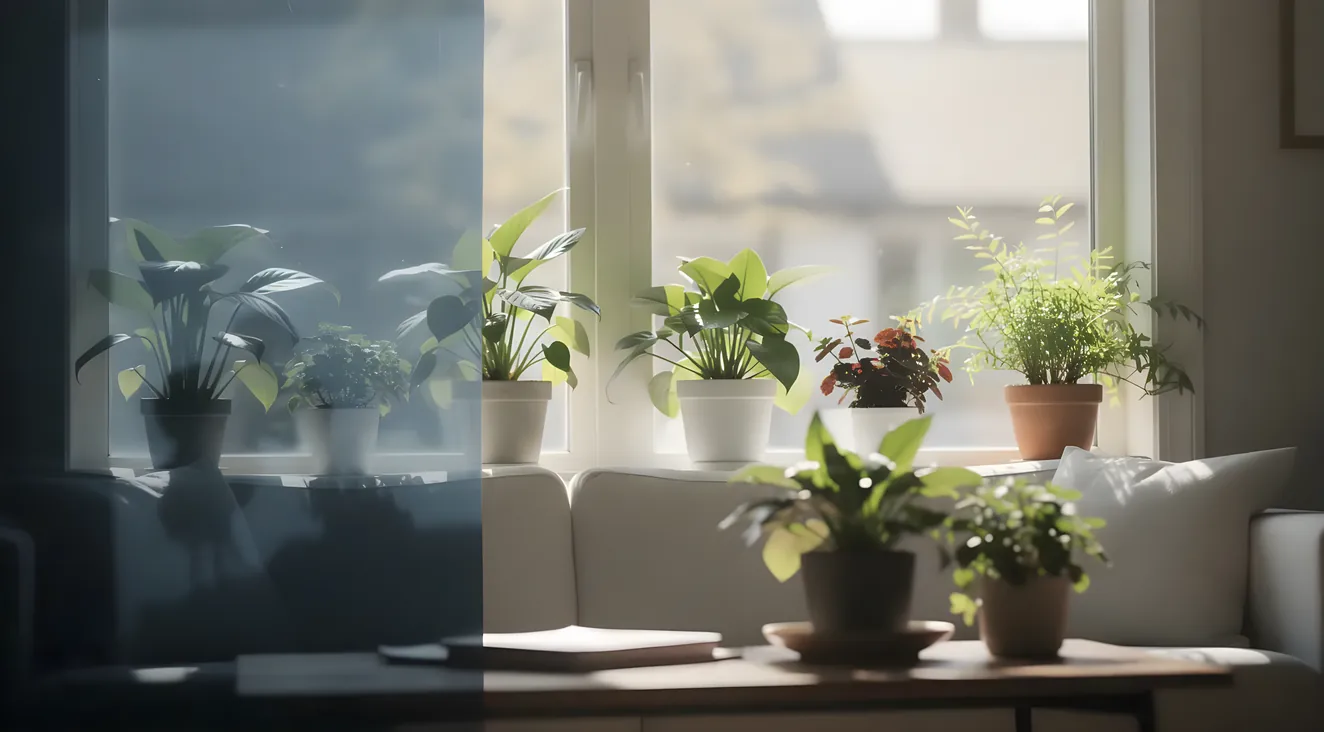
Short answer: window tint can affect a houseplant, but for most common plants the effect is minor to none, and it comes down almost entirely to which film you pick. Plants photosynthesize using red and blue light, not UV, and that’s the reassuring part: they don’t rely on UV to grow. What decides the outcome is how much visible light the film lets through, not whether a window counts as “tinted” in some yes-or-no sense. A film that strips UV but keeps the visible light barely touches what a plant eats; a film that darkens a room by half is a different story. And there’s a twist: tint can sometimes help a plant that’s struggling with heat, not just risk hurting one. More on that below.
What Light Do Plants Actually Use to Grow?
Photosynthesis runs almost entirely on red and blue visible light, the band scientists call PAR (photosynthetically active radiation). That’s where chlorophyll’s absorption peaks sit, and it’s the light a plant actually “eats” to make its own food. UV falls outside that range, so blocking it doesn’t starve a plant of anything it needs to grow.
Here’s where the mechanism gets stated wrong a lot: plants don’t rely on UV to grow, but that’s a different claim than saying they don’t respond to UV at all, which isn’t accurate. UV-B light triggers a plant’s own protective pigment production, a defense response rather than a growth one. Blue and UV-A light also power a plant’s ability to repair UV-damaged DNA. Plants do notice UV. They just don’t use it to photosynthesize.
You’ll also hear that blue light grows leaves and red light grows flowers. That’s a handy shorthand, not a rule: both wavelengths drive photosynthesis. The strict split mostly traces back to older grow lights that only came in blue-heavy or red-heavy versions, not to anything fixed in plant biology.
Myth: Plants Need UV to Grow
False. If your film strips UV but keeps visible light coming through, your plants lose nothing they actually use to grow.
Does the Type of Window Film Matter? (Clear, Dark, and Frosted)
The real question isn’t whether your window is “tinted.” It’s how much visible light the film actually lets through: that’s the variable that decides everything for your plants.
| Film Type | Effect on Your Plants |
|---|---|
| Clear / UV-blocking | Strips out UV, keeps most visible light. Barely touches the red and blue light plants use. Safe for sun-loving plants right against the glass. |
| Dark / room-darkening | Cuts into the same red/blue band plants photosynthesize with, not just UV. A sun-loving plant may struggle; a low-light plant probably won’t notice. |
| Frosted / decorative | Diffuses light rather than removing it. Minimal effect on a plant already getting adequate light, at most a short adjustment period. |
How much light a film lets through is measured as VLT, rated by NFRC, and that number predicts what happens to your plants. I’m not walking through the percentages here. If you want to know how dark your film actually is, that’s covered in the different VLT levels.
At a Glance: What to Actually Do
Clear / UV-blocking: No action needed. Safe for any plant, even right on the sill.
Dark / room-darkening: Watch sun-loving plants. Move them closer to the glass or add a grow light if growth slows.
Frosted / decorative: Give it a couple weeks. Most plants adjust with no lasting effect.
Can Tint Actually Help a Plant That’s Struggling With Heat?
Here’s the part that surprised me when I looked into it. A plant pressed against hot, unfiltered glass can genuinely suffer, scorched leaf edges and soil drying out faster than you’d expect, from direct heat buildup alone. That’s a separate problem from the light question above.
Spectrally-selective film, sometimes marketed as low-E, ceramic, or nano film, is built to reject infrared heat while keeping visible light high. That’s the real mechanism behind “tint actually helped my plant”: tint doesn’t make plants happier across the board; this specific class of film separates heat rejection from light rejection, so you can cut the heat hitting a window without dimming what your plant needs to grow.
To be clear, this is an honest explanation of why some windowsill plants do better after tinting, not worse, not a pitch for any particular product line.
Look for This Term When You Shop
Low-E, ceramic, and nano film are different marketing names for the same idea: spectrally-selective film that rejects infrared heat while keeping visible light high. If a plant is struggling with heat but not light, this is the film category to ask about, not the darkest tint on the shelf.
What to Do If a Room Gets Too Dark for Your Plants
If a darker film noticeably dims a room, the fix is a supplemental grow light near the plant that’s struggling, not tearing out the film or relocating every pot in the house.
A modest full-spectrum LED grow light is the standard, low-cost option. Placed a foot or two from the plant, it’s enough for most common houseplants. Brightness matters more than wattage here, which is why grow lights are usually rated by coverage or output instead of watts.
This is the same advice extension services give homeowners whose natural light falls short indoors, tinted windows or not. Window film just changes how much natural light a room delivers in the first place; the fix on the other end doesn’t change.
One more thing worth knowing: a room that feels bright to you can still be dimmer than your eyes suggest to a plant. That’s worth remembering even before you touch a single window.
Grow Light Quick Reference
- Type: full-spectrum LED
- Placement: 1 to 2 feet from the plant
- What to check: coverage or output rating, not watts
Frequently Asked Questions
What color light is worst for plant growth? Green light does the least for a plant, since leaves reflect it rather than absorbing it, which is why leaves look green in the first place. Red and blue light do the heavy lifting for photosynthesis, so a heavily darkened film, which cuts deep into those wavelengths, matters more to a plant than a film that only strips out UV.
Is sunlight through glass enough for plants? For nearly every common houseplant, yes. Ordinary window glass already passes the visible light plants use, and adding a clear or spectrally-selective film changes that only slightly. It’s only once a film cuts deep into visible light, the kind of dark, room-darkening tint, that “enough” becomes a real question.
Are tinted windows bad for indoor plants? Not automatically. A clear, UV-blocking film has almost no effect. A dark, room-darkening film can genuinely challenge a sun-loving plant, because it’s cutting into the light band the plant needs, not because tinting itself is the issue.
What is the best window tint for plants? A clear/UV-blocking film or a spectrally-selective film. Both let most of the visible light through while handling UV, and the spectrally-selective option handles heat too. Save the darkest films for windows without sun-loving plants nearby.
How far away from a window can a plant be? There’s no fixed distance, since light drops off fast the farther you get from the glass. If a new film dims a room, a plant that was thriving right at the window may need to move closer, not farther. High-light plants generally do best within a few feet of a bright, unobstructed window no matter what film you have.