
Choosing a garbage disposal comes down to five things that actually separate a good unit from a bad one: feed type, horsepower, grind stages, grind chamber material, and sound insulation. Warranty length is the sixth number worth checking, because it tracks almost exactly with build quality across every brand out there.
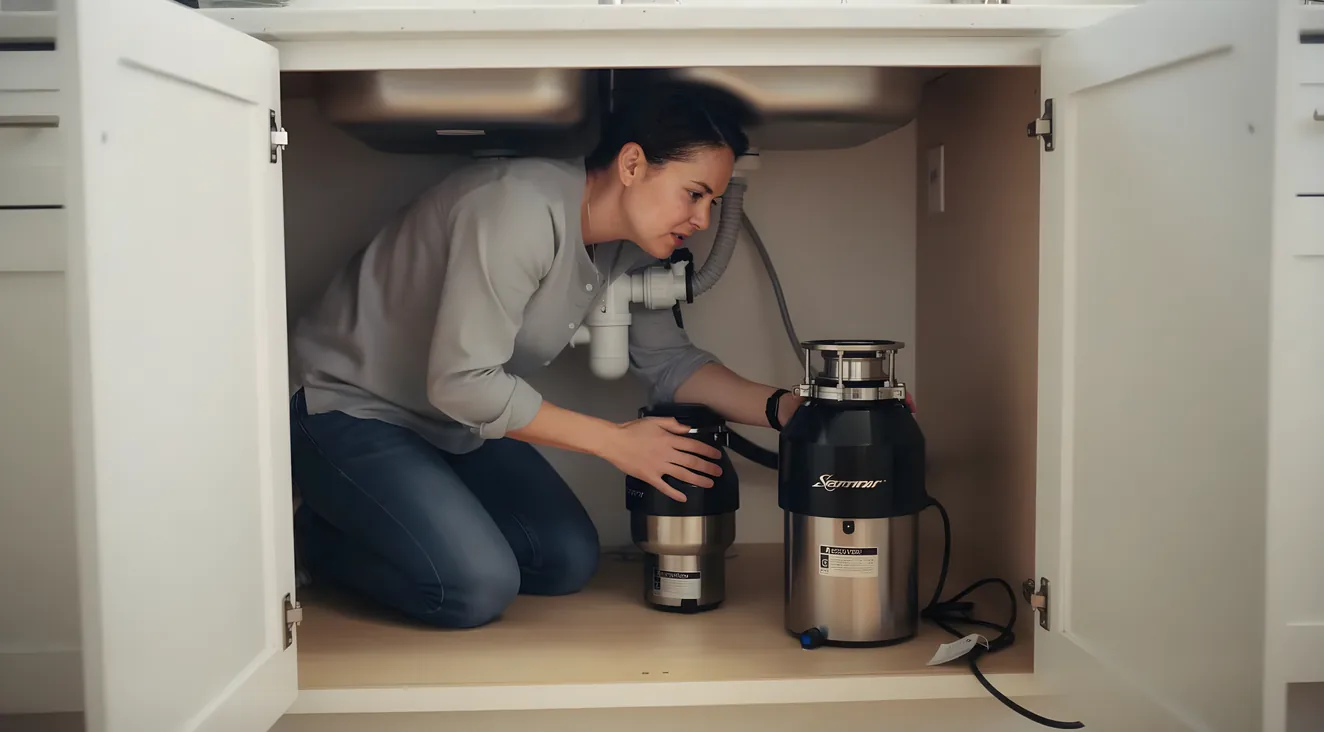
If you’re standing under your sink right now trying to decide between 1/2 HP and 3/4 HP, here’s the short version: a 1/2 HP continuous-feed disposal with a stainless steel grind chamber covers most two-to-four person households doing normal, everyday food scraps. The jump to 3/4 HP earns its keep on fibrous waste (celery, corn husks) and bones, and on bigger households, not because it grinds “harder” on soft stuff.
Price mostly buys warranty length, sound insulation, stainless steel, and multi-stage grinding, not more raw grinding force for everyday waste. Consumer Reports found the same pattern when it broke down what actually separates a $60 disposal from a $750 one.
And before you spend anything: a disposal that’s jammed, humming, or leaking isn’t automatically dead. I’ll get to that first, because it’s the fastest way to save yourself the whole purchase.
Before You Buy, Make Sure You Actually Need a New One
A disposal that hums but won’t spin, jams every other use, or leaks under the sink feels like a death sentence for the unit. Most of the time it isn’t. A stuck impeller plate, a worn splash guard, or a loose connection under the sink are often a five-minute fix, not a $150 purchase.
Before you shop for anything, figure out what’s actually wrong with it. Humming with no spin usually means something jammed the impeller plate, which you can often clear yourself with an Allen wrench and the reset button. A slow drain isn’t always the disposal at all; it can be the trap or the line past it.
If you’ve already narrowed down the problem, a cheap part might fix it instead of replacing the whole unit. A splash guard, a mounting gasket, or a reset switch runs a few dollars and takes less time than driving to the store for a new disposal.
If you’ve ruled that out and you’re actually buying, here’s what to look at.
At a Glance: Is It Actually Dead?
Humming, won't spin
Jammed impeller plate. Clear it with an Allen wrench and hit reset.
Draining slow
Often the trap or the line past it, not the disposal itself.
Leaking under the sink
Check the splash guard, mounting gasket, or a loose connection first.
Continuous Feed vs. Batch Feed: The First Decision
Before horsepower, before anything else, decide how you want to load the thing.
A continuous feed disposal runs while you’re actively feeding scraps in, controlled by a wall switch. It’s the type most people picture: open mouth, flip the switch, grind while you go. Continuous feed units are generally cheaper, faster to install, and handle a higher practical volume, since you’re not stopping to load and cap it between batches.
A batch feed disposal only runs once you drop a stopper or lid into place. That stopper is doing two jobs at once: it’s the safety interlock (nothing runs unless it’s sealed), and it’s a sound dampener, since it closes the grind chamber off from the open air while the motor is running. Batch feed units cost more upfront. Consumer Reports notes batch feed models cost more than continuous feed on average, and they make up a small share of the market, so options are limited. The overall range across tested disposals runs about $60 to $750.
Continuous feed wins on speed, cost, and everyday volume. Batch feed costs more and grinds a little slower, but the stopper makes it the safer setup around an open, running grind chamber.
Here’s my actual recommendation. If you’ve got young kids who might reach toward an open, running disposal, batch feed is worth the premium. The stopper is a real physical barrier, not just a suggestion. For most other households, continuous feed is the default, and it’s what most of the units later in this guide are built around.
Continuous Feed vs. Batch Feed
Continuous Feed
Cheaper, faster install, higher everyday volume. Runs while you feed scraps in via wall switch. The default pick for most households.
Batch Feed
Costs more, grinds a little slower. Only runs with the stopper sealed, which doubles as a real safety barrier. Worth the premium with young kids around.
Horsepower by Household Size (the Question Everyone Actually Asks)
This is the question I get asked more than any other, and it’s the one most buying guides dance around instead of answering directly.
Here’s the direct answer: a 1/2 HP unit covers most primary residences with two to four people doing normal, everyday cooking scraps. That’s the realistic floor for a homeowner who isn’t doing anything unusual under the sink. The jump to 3/4 HP matters when you’re grinding fibrous waste (celery strings, corn husks, potato peels) or bones regularly, or when you’re feeding a bigger household. It’s not about “more power” grinding soft produce harder; it’s about less strain and fewer jams on the tougher stuff.
Broken down by tier:
- 1/3 HP: light duty. Fine for one or two people doing occasional, soft scraps only. This is a bare-minimum unit, more common in a rental or vacation home than a full-time kitchen.
- 1/2 HP: the realistic floor for a homeowner’s primary residence. Two to four people, standard everyday use. If you’re replacing a dead 1/2 HP unit with normal cooking habits, there’s no real reason to jump tiers just because you’re already buying.
- 3/4 HP: a family of four, more fibrous or bone waste, and it typically comes with better sound insulation in the same product line, since manufacturers tend to bundle those upgrades together.
- 1 HP and up: five or more people, or heavy and frequent grinding. This is also the tier where physical size starts mattering; a 1 HP unit can run taller than the standard range above, which matters if your under-sink clearance is tight (more on that below).
Here’s the misconception I want to correct. Horsepower is about stall resistance, how much load the motor can push through before it bogs down, not about how “sharp” the grind is on everyday soft waste. A 1/2 HP and a 1 HP unit will both turn a banana peel into mush without any trouble. The difference only shows up when you feed something that fights back.
So if you’re a one or two person household mostly grinding soft produce trimmings, paying for 3/4 HP or higher is often wasted money. If you’re cooking for a bigger family, or your kitchen regularly deals with bones and fibrous scraps, the upgrade earns its keep.
Grind Stages and Chamber Material: What Separates a Unit That Lasts
Two specs that don’t show up in the marketing headline but matter more than almost anything else for how long the unit actually lasts: grind stages and chamber material.
Grind stages. A single-stage disposal grinds waste once, in one pass through the impeller plate and grind ring. A multi-stage unit (two-stage, or three-stage on units marketed as “Multi-Grind”) runs waste through additional passes before it clears the chamber. The practical difference shows up on stringy or fibrous waste: corn husks, celery strings, small bones. A single-stage unit is more likely to jam on that stuff; a multi-stage unit is built specifically to resist it.
Chamber material. This is the spec I’d check first if I were buying today. Stainless steel grind chambers resist corrosion because of the chromium in the alloy. Galvanized chambers are zinc-coated steel, and once that coating chips or wears down from years of food acid and water exposure, the steel underneath starts to rust. In practice, a corroded grind chamber is a more common failure mode than the motor actually burning out. The disposal doesn’t usually die because the motor gave up; it dies because the chamber rusted through.
Entry-level units don’t always lead with chamber material on the box or the product page, so this is a spec you have to go check yourself rather than assume. Look for “stainless steel grind chamber” specifically in the product description, not just “stainless steel” applied to the sink flange or the outer housing.
Sound Insulation: What “Quiet” Actually Means
“Quiet” gets thrown around on every disposal’s marketing copy, so here’s what the actual range looks like.
A standard, uninsulated disposal is noticeably louder than an insulated “quiet” model, loud enough that you’ll want the kitchen door closed or notice it from another room. An insulated model, by comparison, runs more like a hum you can talk over.
Three things drive that difference: foam or composite insulation packed around the housing, the type of motor, and anti-vibration mounting that keeps the unit from transmitting noise through the cabinet and the sink itself. I can’t attribute a specific decibel reduction to any one of those three factors on its own. No manufacturer spec breaks it down that precisely. What’s consistent is the mechanism: more insulation, a quieter motor design, and better vibration isolation together produce a noticeably quieter unit.
Consumer Reports’ framing on this matches what I’d tell a friend directly: a chunk of what you’re paying for at the premium end of the price range is thicker sound insulation, not more grinding power. Standard units keep the price down; insulated “quiet” models cost more but grind noticeably quieter. If a quiet kitchen matters to you (open floor plan, kids napping, apartment-style walls), it’s worth paying for specifically, not assuming you’ll get it by default.
Physical Fit and Plumbing: Measure Before You Shop
Before you buy anything, get a tape measure under your sink. This is the step people skip and end up regretting.
Measure three things while you’re down there:
- Vertical clearance: 12 to 16 inches from the sink drain down to the cabinet floor, enough room for the unit itself plus the P-trap underneath it.
- Depth behind the unit: 3 to 6 inches clear for the drain elbow, and more if a dishwasher connects into the same setup.
- Typical body size: 10 to 15 inches tall, 5 to 9 inches wide, and 6 to 13 inches deep for most units. Higher horsepower units run bigger; a 1 HP unit can run taller than that standard range, which is exactly where that under-sink clearance measurement matters most.
Drain line size is rarely the blocker it sounds like. Most residential kitchens run a standard 1.5-inch drain pipe, and that’s what nearly every disposal is built to connect to. Still worth a quick look at what you’ve currently got before you assume, but it’s not usually something that differs model to model.
Two more things to check while you’re under there: whether your current setup runs on a cord and plug or is hardwired (some units need a cord-and-plug conversion kit if you’re switching types), and whether a dishwasher connects to the disposal. If it does, you’ll need the dishwasher inlet knockout tapped out on the new unit; if it doesn’t, leave it sealed.
Warranty Length: The Cleanest Proxy for Build Quality
If you only check one number besides horsepower, make it the warranty term. Across every manufacturer I looked at, warranty length tracks directly with product tier, which makes it a legitimate shorthand for which tier you’re actually buying, even when you can’t see the internal parts yourself.
Here’s what the manufacturers actually publish. InSinkErator’s Pro 750 (3/4 HP) carries a 10-year warranty. Moen’s Prep Series (1/2 HP) carries 5 years, while its Host Series (3/4 HP) and Chef Series (1 HP) both carry 10 years with in-home service included. Waste King’s range runs from 2 years on its entry-level L-1001 EZ Mount up to 10 years on the L-8000TC.
That’s the honest answer to “which brand is most reliable,” too. I’m not going to manufacture a verdict there, because nothing I found actually supports naming one brand over the others. What’s true is that InSinkErator, Moen, and Waste King all publish a 10-year warranty at their top tier. Worth knowing: Moen owns Waste King, so those two aren’t fully independent data points, they’re one company managing two product lines. The real proof is InSinkErator, a separate company (owned by Whirlpool), landing on the same 10-year number at its own top tier. That’s the pattern holding outside Moen’s own lineup, not just within it.
Published Warranties by Tier
| Model | HP | Warranty |
|---|---|---|
| Moen EX50C (Prep Series) | 1/2 | 5 years |
| Moen EX75C (Host Series) | 3/4 | 10 years |
| Moen EX100C (Chef Series) | 1 | 10 years |
| InSinkErator Pro 750 | 3/4 | 10 years |
| Waste King L-1001 EZ Mount to L-8000TC | varies | 2 to 10 years |
Moen owns Waste King. InSinkErator (owned by Whirlpool) is the independent confirmation that 10-year warranties cluster at the top tier across separate companies, not just within one brand's lineup.
Five Current Units That Show These Specs in Action
Here’s how those criteria actually play out on units you can buy right now. Think of this as five worked examples, not a ranked list. Each one is the clearest illustration of a tier or use case from the sections above.
Moen EX50C (Prep Series, 1/2 HP). The realistic floor pick for a standard two-to-four person household doing normal cooking scraps. It carries a 5-year warranty with in-home service, which lines up with where you’d expect an entry-tier unit to sit.
InSinkErator Pro 750 (3/4 HP). This is where the HP jump from the tier above earns its keep: stainless steel components and multi-stage grinding built in, backed by a 10-year warranty.
Moen EX75C (Host Series, 3/4 HP). Same horsepower tier as the Pro 750, but a good illustration of how warranty length climbs sharply once you move up a product line within a single brand: 10 years, double the Prep Series.
Moen EX100C (Chef Series, 1 HP). The heavy-duty pick, built for five-plus person households or kitchens that regularly grind bones and fibrous scraps. It also carries a 10-year warranty, matching the Host Series above it.
Waste King L-8000TC. A 10-year warranty at the premium tier, worth including because it’s still a real, separately managed product line, even though Waste King shares a parent company (Moen) with the Host and Chef Series above. The independent confirmation comes from InSinkErator, a genuinely separate manufacturer landing on the same 10-year number.
Notice the pattern across all five: warranty length climbs with tier, not randomly, and it climbs in step with the other specs (stainless steel, multi-stage grinding, sound insulation) covered above. That’s not a coincidence; it’s the manufacturer telling you how confident they are in that specific build.
Garbage Disposal Buying Questions, Answered
Should I get a 1/2 or 3/4 HP garbage disposal?
Go with 1/2 HP if you’re a typical two-to-four person household doing normal, everyday food scraps. Step up to 3/4 HP if you’re regularly grinding fibrous waste like celery or corn husks, or bones, or if you’re cooking for a bigger household. The upgrade buys you less strain on tougher waste, not a harder grind on soft stuff.
How do I know what garbage disposal I need?
Work through it in this order: pick your feed type first (continuous vs. batch, mostly a household-safety call), then match horsepower to your household size and cooking habits, then measure your under-sink clearance, and finally use stainless steel and sound insulation as your tiebreaker between similarly priced options.
Do I really need a 3/4 HP garbage disposal?
Not if you’re a one or two person household doing mostly light, soft-food waste; 1/2 HP handles that fine. If you’re cooking regularly for three or more people, or grinding fibrous scraps and bones often, the 3/4 HP tier is worth the extra cost.
Which is better, 1/2 HP or 1/3 HP garbage disposal?
For a primary residence, 1/2 HP. A 1/3 HP unit is built for light, occasional use, more suited to a rental or a vacation home than a kitchen you cook in every day. 1/2 HP is the realistic starting point for most homeowners.
What’s the average lifespan of a garbage disposal?
Skip the vague “about twelve years” figures floating around online and use warranty length as your guide instead, since it’s the one number manufacturers actually stand behind. All three brands I researched publish warranties that scale with build quality, and that scaling is a solid proxy for how long a unit is designed to last. See the warranty section above for the specific terms by tier.
Do I need a 1/2 HP or 3/4 HP garbage disposal?
Same call as above: 1/2 HP for typical households doing normal cooking scraps, 3/4 HP once fibrous waste, bones, or a bigger household enter the picture. Scroll back up to the horsepower section for the full breakdown by tier.
What is the most reliable brand of garbage disposal?
There’s no winner to hand you here. Nothing in the manufacturer data supports singling one brand out. What I can tell you: InSinkErator, Moen, and Waste King all publish warranties that scale with product tier, and that scaling is a better signal of confidence than picking a “best brand” based on reputation alone.
Once You’ve Picked One
Once you’ve worked through feed type, horsepower, grind stages, chamber material, and sound insulation, and you’ve measured what’s actually going to fit under your sink, you’re not guessing anymore. You know which unit fits your kitchen and why.
From here, the actual swap is a separate job. If you want the full install walkthrough once you’ve got a unit picked out, that’s where I’d go next; it covers the mounting ring, the drain assembly, and the wiring hookup that this post deliberately skipped.
I’ve stood under enough sinks comparing specs to know the decision gets easier once you stop treating it like one single “best” choice and start treating it like five smaller ones. Match each spec to how your kitchen actually gets used, and the right unit is usually obvious.