
French casement windows are two side-hinged sashes that crank outward together and meet in the middle, with no center mullion between them when both are open. Nothing about them slides up or down. That’s what a double-hung window does, not a casement of any kind, and if you’ve read a different explanation somewhere else on the internet (including, I’ll admit, an old version of this post), it was wrong.
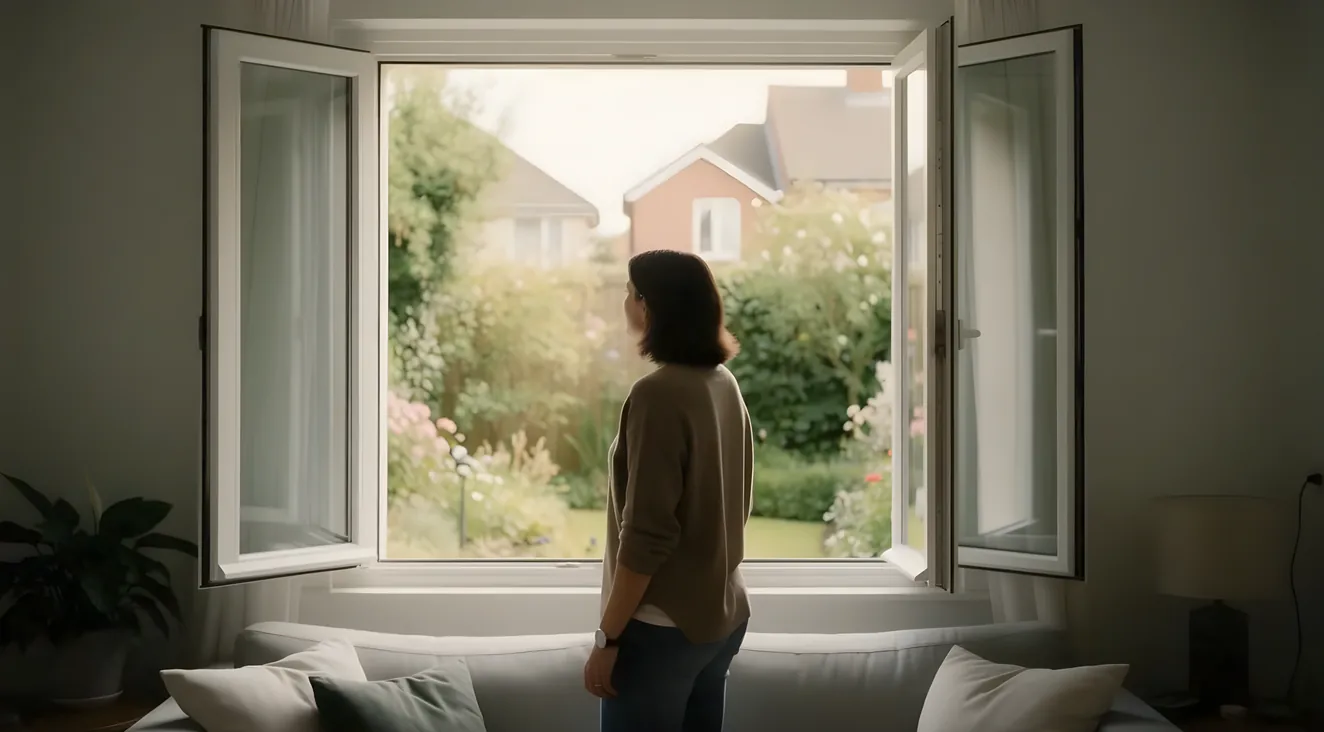
A standard casement is one sash, hinged on one side, cranked out like a door. A French casement is two of those, mirrored around the center, with a “flying mullion” that lets the second sash lock against the first instead of a fixed vertical post staying put between them. That’s the visual tell: look at a French casement wide open and there’s nothing standing in the middle. Look at two ordinary casements installed side by side and there’s a post between them the whole time.
Here’s the short version of the verdict, before you read the rest: French casements are excellent for airtightness, security, and an unobstructed view when open. They’re a poor fit if you don’t have clear exterior swing space, if you’re dealing with regular high wind without an impact-rated unit, or if you’re planning to run a window AC unit in that room. I’ll walk through all three, plus the real costs and the stuff nobody selling these windows wants to tell you.
They also tend to look right on a specific kind of house. French, Colonial, and Craftsman-style homes suit them, since the double-sash opening echoes the look of an actual pair of French doors, just scaled down to window size. They show up a lot over kitchen sinks and counters too, for a reason I’ll get into below.
What a French Casement Window Actually Is (And Isn’t)
Let me be precise about the mechanism, because this is where most of the confusion online starts. A French casement is two side-hinged sashes, hinged on the outer edges of the frame, that crank or push open outward, away from the house. Picture opening a pair of French doors from the inside. That’s the motion, just at window scale instead of door scale.
It is not a window that slides up and down in a track. That’s a double-hung (or single-hung) window, and the mechanics are completely different: weights or springs holding a sash in place as it travels vertically, versus a hinge and a crank arm swinging a sash outward. I’ve written up how that other window operates in a separate post, since it isn’t the subject of this one.
One more mix-up worth clearing up while I’m at it: “French windows” and “French doors” are not the same thing as a French casement window, even though you’ll see them used interchangeably on some sites. French doors are full-height glazed doors, hinged like, well, doors. A French casement is a window: it sits in a wall opening, not a doorway opening, and it doesn’t have a threshold or a door handle. The family resemblance is real (both are pairs of hinged, glazed panels that swing outward), but one lets you walk through it and one doesn’t.
The detail that actually matters when you’re deciding whether to buy one: when both sashes of a French casement are open, there’s no center post standing between them. That’s the whole point of the design, and it’s worth checking on the specific unit you’re looking at, because not every window marketed as “French casement” delivers it. Some cheaper units keep a fixed mullion in the middle for structural reasons, which defeats a lot of the appeal.
Quick Check: What It Isn't
Not a double-hung
Nothing slides up or down. Both sashes crank outward.
Not French doors
It's a window in a wall opening, no threshold, no door handle.
Not two casements side by side
No fixed post stands between the sashes when both are open.
How the Crank-and-Flying-Mullion Mechanism Works
Here’s the part that makes a French casement different from just two windows bolted together. One sash, the primary, cranks or pushes open first. The second sash, the secondary, doesn’t have its own hinge-side connection to the frame in the middle. Instead, it locks against the primary sash using flush bolts, small spring-loaded pins that engage once both sashes are closed and aligned.
That locking sash edge is what people mean when they say “flying mullion” (you’ll also hear it called a moving mullion). It isn’t a piece of the frame. It’s a strip built into the edge of the secondary sash that only reads as a “mullion” when the window is closed and the two sashes meet. Open the window, and the flying mullion goes wherever that sash goes: outward, on a hinge. That’s why there’s no fixed post standing in the opening when both are cranked out, unlike two ordinary casements set side by side in a shared frame, where the center post is bolted to the structure and never moves.
You’ll sometimes see the technical term “astragal” used for this locking edge in manufacturer literature. It means roughly the same thing as flying mullion in this context. I’m mentioning it once so you recognize it on a spec sheet, not because you need to remember it.
Where French Casement Windows Genuinely Make Sense
I put French casement windows in a kitchen renovation over the sink a couple years back, and the crank operation is the reason. You don’t have to lean over a faucet, dishes, or a soap dispenser to reach a handle at the top of the sash; you turn a crank at counter height and the whole thing swings open. Try that with a double-hung window over the same sink and you’re reaching across the basin every time.
They also fit the look of certain houses in a way that’s hard to fake with other window types. On a French, Colonial, or Craftsman-style home, the double-sash opening, wide and symmetrical, hinged on both outer edges, echoes actual French doors at window scale. It reads as intentional architecture, not just “we needed a window here.” That’s a real reason to spend more on this configuration over a plain single casement, if the house style calls for it.
The third place French casement windows earn their keep is cross-ventilation. A French casement opens the full width of the unit, both sashes cranked outward at once, which moves more air through a room than a single casement or a double-hung window of the same rough opening size (a double-hung, even fully raised, only ever opens half its total window area). If you’ve got a room without great HVAC coverage, a sunroom, a converted porch, a corner bedroom that always runs warm, a full-width opening does real work. Some homeowners also lean on that wide opening to help meet egress requirements in a bedroom. If that’s part of your decision, I’ve covered the code specifics separately in the egress windows post, since that’s its own rabbit hole and not this post’s job.
Three Things That Rule Them Out
Before you fall in love with the look, run your situation against these three. Because the sashes swing out instead of sliding up and down, a French casement needs real exterior clearance, and a standard window AC unit won’t seal against it. I’d treat all three of the disqualifiers below as real deal-breakers, not minor asterisks. A window you can’t fully open, can’t trust in a storm, or can’t cool the room with isn’t doing its job no matter how good it looks closed.
Exterior clearance. A French casement needs somewhere for both sashes to swing into, and it needs real exterior clearance for the full swing arc. The exact amount varies by unit width and manufacturer, so check the install spec for your specific model. If there’s a walkway, a patio, a deck railing, a tight side yard, or landscaping sitting in that swing path, the window either can’t open fully or it’s going to clip something (or someone) every time you crank it. Measure the actual exterior space before you fall for the look. If clearance is the problem, sliders or awning windows are worth a look instead, since neither one needs room to swing outward. And if the opening size itself is part of what’s constraining your options, that’s a separate question I’ve laid out in more detail in the standard window sizing guide rather than repeating here.
High-wind and hurricane exposure. An open sash acts like a sail. If the multi-point lock isn’t fully engaged before a gust hits, wind can force the sash further open than you meant and put real stress on the hinges and hardware. But don’t let that turn into a blanket “no casements near the coast” rule, because it’s not accurate. Impact-rated French casements, built with laminated glass and tested to a high Design Pressure (DP) rating, are made for high-velocity hurricane zone construction and are tested against Category 5 wind and windborne-debris standards. The actual trade-off is this: a standard, non-impact-rated unit is the poor fit for that kind of exposure, and stepping up to an impact-rated version costs meaningfully more. Know which one you’re buying before you commit to the location.
Window AC unit compatibility. Standard window air conditioners, and the accordion-style exhaust panels that come with them, are built to seal against a sash sliding in a vertical track. A crank-out sash has no flat track to seal against, so a window AC unit doesn’t sit right in a French casement opening. There are workarounds: fabric zip-seal panels, custom rigid inserts, specialized adapter kits built for casement windows specifically, but every one of them is a compromise, not a clean fit. If you’re planning to run window-unit air conditioning in that specific room, treat this as a real disqualifier and plan around it rather than assuming you’ll figure it out later.
Before You Buy: Check All Three
Exterior clearance
Room for both sashes to swing fully into open air, not a walkway or railing.
Wind exposure
Standard units aren't built for regular high wind. Impact-rated versions are, at a higher price.
Window AC plans
No flat track for a standard unit to seal against. Plan around it, don't assume it'll work.
What They Cost, Installed
Numbers first, sourced, no guessing. A French (double) casement window installed runs roughly $450 to $950 according to Fixr (Fixr), or $725 to $950 according to HomeGuide (HomeGuide). The spread comes down to frame material and finish level more than anything else.
Speaking of frame material, here’s the unit-cost breakdown before installation, per HomeGuide’s material data:
- Vinyl: $200 to $750
- Fiberglass: $500 to $1,500
- Wood: $300 to $2,000
Vinyl is the budget option; wood and higher-end fiberglass carry the premium, both in material cost and typically in how long they last.
For comparison, a single standard casement (not the French, double-sash configuration) installs for roughly $350 to $550 according to HomeGuide, or $225 to $550 according to Fixr (HomeGuide, Fixr), which tells you a lot of the French casement premium is coming from the second sash, the flying mullion hardware, and the more involved installation, not just “more window.”
Installed Cost: French Casement vs. Single Casement
| Configuration | Fixr | HomeGuide |
|---|---|---|
| French (double) casement | $450 - $950 | $725 - $950 |
| Single standard casement | $225 - $550 | $350 - $550 |
Sources: Fixr, HomeGuide. The gap between rows is mostly the second sash, the flying mullion hardware, and a more involved install.
The Trade-Offs Nobody’s Sales Blog Mentions
This is the part every dealer blog skips on French casement windows, and it’s the part that actually matters once you’ve lived with these windows for a few years.
Sash alignment can drift over time. The flying mullion depends on the secondary sash meeting the primary one at exactly the right point to lock and seal. Hinges settle, frames shift slightly with the house, and a window that closed flush and tight the day it went in can develop a gap or a harder-to-latch feel a few years later. It’s not a defect so much as a mechanical reality of having two moving sashes instead of one fixed frame.
Screening is a real compromise, not a footnote. Casement-style windows can only take interior-mounted screens, because an exterior screen would sit directly in the path of the swinging sash and get damaged or block the window from opening at all. An interior screen works, but it partially blocks the crank handle, and it cuts down on airflow compared to what you’d get through an exterior screen on a different window type. You gain the ventilation from the full-width opening; you give some of it back at the screen.
Reach and ergonomics catch people off guard, especially over a counter or sink. I mentioned earlier that the crank makes these windows easier to operate than reaching over a faucet, and that’s true for opening them. Closing them from directly in front of a deep sink or a wide counter is a different story if you’re not tall; you’re leaning and reaching either way, just with a crank arm instead of a sash lift. If you’re on the shorter side, actually stand at the counter and mime the motion before you commit to the placement.
And the one nobody warns you about: a fully open sash sits at head height, and if it’s positioned near a stairway, a narrow hallway, or a tight walkway, it’s a real collision hazard. I’ve watched a French casement swing open next to a staircase and thought immediately: that’s going to catch someone in the head who isn’t paying attention. It’s not a hypothetical. Think through the actual foot traffic near the window before you install one there, not just the view from inside.
Living With It: Four Things to Expect
Alignment drifts
Years in, the sashes may not meet as tightly as day one.
Screens mount inside only
They work, but they get in the way of the crank.
Reach changes by task
Easy to open over a counter, awkward to close if you're not tall.
Head-height hazard
A fully open sash near a stairway or hallway is a real collision risk.
French Casement vs. Your Other Options
If you’re comparing against a single standard casement, the trade is straightforward: a single casement fits a narrower opening, costs less (that $350 to $550 installed range from above), and doesn’t need the flying mullion hardware at all. It’s the right call when you don’t need the full-width opening or the symmetrical look and you’d rather save the money.
Against a double-hung window, the appeal runs the other way for a lot of homeowners: lower cost, no exterior swing clearance required at all since the sashes move vertically inside the frame instead of swinging out, and an operation everybody already knows how to use. That familiarity and the zero-clearance requirement are the two real reasons someone picks double-hung over a French casement. I’m not going to re-explain how a double-hung window’s sash-and-track system works here since I’ve already covered that in detail in how a double-hung window operates.
Frequently Asked Questions
What is a French casement window?
It’s a pair of window sashes, hinged on the outer edges of the frame, that crank or push outward together and meet in the center. When both sashes are open, there’s nothing standing between them: the “flying mullion” built into the sash edge takes the place of a fixed center post. It doesn’t move vertically at any point in that operation.
What is the difference between a French casement and a regular casement window?
A regular casement is a single sash on a single hinge, opening in one direction. A French casement takes two of those sashes and mirrors them around a center line, with the second sash locking against the first through flush bolts instead of a fixed post staying in the middle. One window, one hinge, versus two windows engineered to open and close as a matched pair.
What are common problems with French casement windows?
The hardware and seal generally hold up well early on, but real ownership brings a few specific friction points: the sash alignment can drift enough over the years to affect how tightly the window closes, the screen has to mount on the inside and gets in the way of the crank handle, reaching the crank over a deep counter or sink is awkward if you’re not tall, and a sash swung fully open near a stairway or narrow hallway sits at head height, which is a genuine bump-into-it hazard.
What style homes suit French casement windows?
French, Colonial, and Craftsman-style homes are the strongest architectural fit, since the wide, symmetrical double-sash opening reads as a scaled-down version of actual French doors. They also do well in kitchens over a sink or counter, since operating a crank doesn’t require leaning over a fixture the way lifting a sash does.
Do Andersen or Pella make French casement windows?
Pella currently offers French casement options in its lineup. Andersen’s E-Series French casement, as of this writing, carries a discontinued-product notice, meaning it’s no longer available to special-order, though existing units can still get service and parts. Worth checking directly with the manufacturer before you shop by brand, since product lines change.
So, the actual answer to the question in the title: if you’ve got the exterior clearance, you’re not fighting regular high wind without an impact-rated unit, and you’re not planning to run a window AC in that room, French casements are one of the better upgrades you can make. Real airtightness, real security from a multi-point lock that’s materially harder to force than a single sliding latch, and a view with nothing standing in the middle of it. If any one of those three disqualifiers applies to your situation, I’d put your money into a different window type instead, sliders, awnings, or a straightforward double-hung, and save the French casement for an opening where it can actually do what it’s built to do.