
The right speaker wire gauge for your home theater depends on two things: how far the wire runs and whether your speakers are rated at 8 ohms or 4 ohms, not brand, price, or marketing. For a typical 8-ohm speaker on a run under 50 feet, 16 AWG wire is the right call. Past that distance, or with 4-ohm speakers at any distance, you need to step up a gauge. Every legitimate chart comes from the same rule: keep total wire resistance under roughly 5% of the speaker’s impedance so you don’t lose power or loosen the amp’s control over the cone.
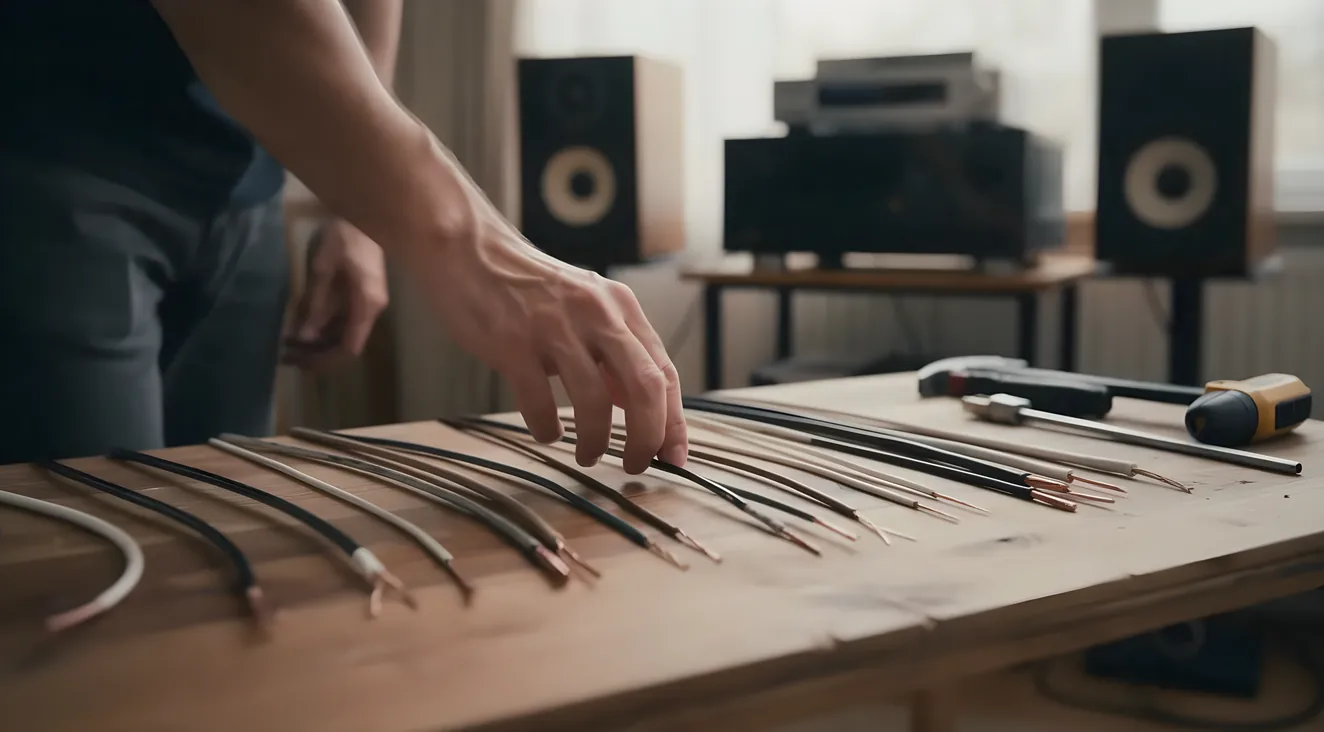
Four-ohm speakers cut those same distances roughly in half, because a 4-ohm speaker can only absorb half as much resistance before crossing that same 5% line. If you’ve searched for a speaker wire gauge calculator or a speaker wire gauge chart, both ask the same two things: your run length and your speaker’s impedance.
This post assumes you already have a rough home theater system in mind, speakers, receiver, source, and just need the last piece: matching wire to the run. I ran into this exact question wiring my own setup, and got three different answers from three different charts before working out why they weren’t actually disagreeing. That reconciliation is below, along with the resistance math so you can check the numbers yourself.
How AWG Actually Works (and Why 12 Is Thicker Than 16)
American Wire Gauge, AWG for short, is a real engineering standard (ASTM B258) for sizing round copper conductors. AWG predates home audio: it sizes speaker cable, appliance cords, and in-wall electrical wiring under the same standard. The part that trips people up is that the numbers run backward from what feels intuitive: a lower gauge number means a thicker wire, and thicker wire has less resistance. So 12 AWG is thicker, and carries current over distance better, than 16 AWG.
Each 3-gauge step roughly doubles the wire’s cross-sectional area and halves its resistance per foot; each 10-gauge step multiplies that area by about ten. Home speaker wire mostly comes in four sizes, 18, 16, 14, and 12 AWG, with 10 AWG for very long or high-current runs. Once you know which number fits your run, buying the wire is the easy part.
The Gauge-by-Distance Table for 8-Ohm Speakers
Most home theater speakers are rated at 8 ohms, so start here. The rule every credible source uses is the same: keep total wire resistance under about 5% of the speaker’s impedance. For an 8-ohm speaker, that works out to roughly 0.4 ohms of allowable wire resistance, total. Stay under that and the power loss and the hit to damping factor, a measure of how tightly the amp controls the speaker cone, both stay small enough to be inaudible. Go well past it and bass starts to sound loose, because the amp is fighting its own cable instead of the speaker.
Here’s the chart that follows from that rule, reconciled against the resistance math behind it rather than a rule of thumb someone repeated without checking:
| Run length (one-way) | Recommended gauge |
|---|---|
| Up to ~50 ft | 16 AWG |
| ~50-100 ft | 14 AWG |
| 100 ft and beyond (up to ~200 ft) | 12 AWG |
You can check the first row yourself. Standard 16 AWG stranded copper runs about 4.02 ohms per 1,000 feet. A 50-foot run needs 100 feet of actual conductor, because current has to travel out to the speaker and back to the amp. That’s 100 feet times 4.02 ohms per 1,000 feet, which comes out to about 0.40 ohms, landing almost exactly on the 8-ohm ceiling. That’s not a coincidence. It’s where the “50 feet” number in this chart, and most others, actually comes from.
That same math is happening at the other end of the run too, inside your receiver’s output stage. If you haven’t settled on your receiver yet, that’s a decision worth making before you commit to a wire run, since the two work together.
The Formula, So You Can Check Any Run
- Multiply your speaker's rated impedance by 0.05. That's your total wire resistance ceiling, in ohms.
- Double your one-way run length. Current travels out to the speaker and back.
- Multiply that doubled length (in thousands of feet) by the wire's ohms-per-1,000-ft rating. Stay under the ceiling from step one.
Why 4-Ohm Speakers Cut Every Distance in Half
Not every speaker is 8 ohms. Some home theater speakers, especially towers and in-wall models, run at 4 ohms, which changes the math directly. The 5%-of-impedance ceiling isn’t fixed, it’s a percentage of the speaker’s own rating. A 4-ohm speaker can only tolerate about 0.2 ohms of wire resistance before crossing that same line, half of what an 8-ohm speaker allows, which cuts every distance in the gauge chart above roughly in half.
Speaker Says "4-8 Ohms"? Size the Wire for 4
That rating means the drivers inside aren't matched to each other, not that you get to pick whichever number is convenient. Use the 4-ohm distance table for that speaker. Sizing up costs nothing, and it keeps a long run from surprising you later.
| Run length (one-way) | Recommended gauge (4-ohm) |
|---|---|
| Up to ~25 ft | 16 AWG |
| ~25-50 ft | 14 AWG |
| 50-100 ft | 12 AWG |
One practical flag: a speaker labeled “4-8 ohms” usually has drivers rated differently from each other. Size the wire as if it’s 4-ohm anyway. It costs nothing to stay on the safe side, and it saves you from finding out the hard way on a 60-foot run.
Should you use 12 or 14 gauge wire? Distance and impedance together decide that, not gauge alone, which is why speaker choice and wire gauge end up connected. If you’re still working out which speakers to buy, their rated impedance is one more thing worth checking first.
Why Every Chart You Find Gives a Slightly Different Number
If you’ve already looked around online, you’ve probably run into three different answers for when to step up from 16 AWG. Crutchfield, an AV retailer whose buying guides show up across most speaker-wire searches, puts the rule of thumb at around 50 feet. Sonos, the wireless speaker maker, says 80 feet on its own support page. And Klipsch’s own gauge-by-distance table says 16 AWG maxes out at 48 feet before you’d move to 14 AWG, which itself is good to 80 feet.
Those aren’t competing answers. They describe two different gauges’ own limits, not the same wire. Klipsch’s 48 feet is where 16 AWG’s usefulness ends at 8 ohms; its 80 feet is where 14 AWG’s usefulness ends at that same impedance. Sonos’s 80-foot figure matches Klipsch’s number for 14 AWG, it’s just describing a different gauge than Crutchfield’s 50-foot rule of thumb describes. Read each number as belonging to a specific gauge instead of one blanket rule, and the apparent disagreement disappears.
This is exactly the mix-up that made the old version of this guide look contradictory, and it’s probably behind a lot of the conflicting charts you’ve seen elsewhere too: real numbers, for different gauges, presented as competing claims about the same spool of wire.
Does Oxygen-Free Copper Actually Matter?
Oxygen-free copper, OFC, is a real material category, not a term someone invented for a label. It’s copper refined down to roughly 0.001% oxygen content or lower, which nudges conductivity slightly above standard electrolytic-tough-pitch copper, the kind most ordinary wire is made from.
The honest answer: on a typical home theater run, that difference is too small to change which gauge you need, or to produce anything you could actually hear. DALI, a loudspeaker manufacturer with no wire to sell, stops short of claiming conductor material changes what you hear in its own consumer-facing article on speaker wire myths, telling buyers to trust their ears rather than the marketing. Gauge and a clean, tight connection do far more work than the purity of the copper inside the jacket.
Where material genuinely matters is a different comparison: copper-clad aluminum, or CCA. CCA is meaningfully worse, not just oversold, at roughly 61 to 68% as conductive as pure copper. Buy CCA wire and you need to size up about two gauge steps to match what a copper wire of the original gauge would have given you, so 12 AWG CCA performs closer to 14 AWG copper. If the spool doesn’t say “copper” or “100% copper” on it, assume it’s CCA and size accordingly.
Bare Wire, Banana Plugs, or Spades: What Actually Changes
At the amp or receiver end, you’ve got three common ways to make the connection: bare wire twisted and clamped directly into the binding post, banana plugs that push-fit into the post, or spade connectors crimped onto the wire and secured under the post’s screw collar.
None of the three measurably changes the sound, not frequency response, not output level. What changes is reliability: how well the connection holds up over time. Bare wire gives the most direct contact area, but strands fray with repeated disconnects and bare copper oxidizes over time, right at the connection your gauge math assumed was clean. Banana plugs suit gear you rearrange often; spades are the most secure choice for a permanent in-wall run you won’t touch again.
What matters is keeping that connection tight and free of corrosion. A loose or oxidized bare-wire splice can add more resistance than jumping up a full wire gauge would have saved, which makes the connector question a reliability decision, not a sound-quality one. I crimped spades onto every in-wall run in my own setup for exactly this reason. Bare wire I’d already had to re-twist and re-clamp once when a strand worked loose.
Running Wire Inside a Wall? You Need CL2 or CL3
If you’re running wire inside a wall or ceiling cavity rather than along a baseboard, the gauge chart above isn’t the only thing that matters. Ordinary speaker “zip cord” isn’t rated for that kind of run, even when the gauge itself is electrically fine. In-wall and in-ceiling runs fall under NEC Article 725, the section of the National Electrical Code covering Class 2 and Class 3 power-limited circuits, and they require CL2- or CL3-listed cable.
CL2 is rated to 150 volts, CL3 to 300 volts, and CL3 can substitute for CL2 but not the other way around. This is a fire-code requirement, not a sound-quality one, so keep it separate from the gauge decision above. You pick the AWG based on distance and impedance. You separately confirm the jacket is CL2 or CL3 rated before any of it goes near a wall cavity.
CL2 vs. CL3, at a Glance
Rated to 150 volts. Covers most in-wall speaker runs.
Rated to 300 volts. Can substitute for CL2, but CL2 can't substitute for CL3.
Check the jacket print for one of these two ratings before the cable goes into a wall cavity. It's a separate decision from the AWG choice above, not a replacement for it.
Speaker Wire Gauge FAQ
Should I use 12 or 14 gauge speaker wire?
Check run length and impedance together before picking either one. As a starting point, 14 AWG handles most 8-ohm runs out to about 100 feet; step up to 12 AWG beyond that, or past roughly 50 feet with 4-ohm speakers. Full breakdown above.
Which is thicker, 14 or 16 gauge speaker wire?
14 AWG is thicker. AWG runs backward from what feels intuitive: the smaller the number, the thicker the copper and the lower the resistance. 16 AWG is thinner than 14 AWG, not the other way around.
Is 12 AWG speaker wire overkill for a normal living room setup?
For most living rooms, yes. A short run to 8-ohm speakers already sits well under the resistance ceiling on 16 AWG, so jumping straight to 12 AWG mostly adds cost and makes the wire harder to route behind furniture. Save the heavier gauge for long runs or 4-ohm speakers, not a default upgrade.
Does thicker speaker wire always sound better?
No. Once wire resistance is comfortably under the 5%-of-impedance ceiling, more copper doesn’t buy you anything you can hear, it just costs more and is stiffer to route. That’s a different question from OFC versus standard copper, covered above.
What gauge wire do I need for a 100-watt speaker?
Wattage isn’t the deciding factor, distance and impedance are. A 100-watt-rated 8-ohm speaker on a short run does fine on 16 AWG. Power rating only matters at the extremes, very high continuous output on a long run, where the same distance-and-impedance table already points you to 12 AWG anyway.
Match the Wire to the System You’re Actually Building
Every number in this guide assumes two things: how far the wire runs, and what your speakers are rated at. I measured my own rear-channel run with a tape measure the first time, bought wire to match, and came up almost eight feet short once the path actually turned two corners and dropped through a wall cavity. Now I measure with a length of string first, then straighten it out and read the tape, especially on any run that bends: the actual distance is almost always longer than the straight-line number in your head. Check the back of the speaker for its impedance rating before you buy a single foot of wire. Get those two numbers right and the tables above do the rest.
Two Numbers to Confirm Before You Buy
Measure with a length of string, not a tape measure. Corners and wall cavities add distance a straight-line guess misses.
Check the back panel or the manual. That number decides which chart above applies.